

Enterprises are pouring money into generative AI (GenAI), yet most still struggle to prove business value. In fact, a recent MIT study found that 95% of AI investments produce no measurable return.
Let’s be clear: the lack of measurable return often isn’t due to a lack of value, but rather the difficulty of measuring that value or return on investment (ROI). When you can demonstrate the ROI you’ll have an easier time:
- Getting buy-in: Boards and executives fund what they can verify. A data-backed claim beats a list of flashy features every time.
- Prioritizing investments: Rank use cases by value relative to cost. This helps say no to shiny tools that don’t move the needle.
- Setting up long-term success: Good measurement keeps the focus on creating business value. You can scale what works and stop what doesn’t.
- Selecting the right vendors: Compare AI platforms by business results and total cost to value, not model scores or list prices.
To prove value, leaders need a framework that ties AI to the three most common ways enterprises see AI ROI: cost savings, revenue growth, and risk reduction. Use this guide to turn AI from an abstract promise into tangible business outcomes.
The AI ROI measurement framework
With the following framework, you’ll be able turn broad AI objectives into a short list of measurable indicators. By tracking how those numbers move after launch, you can convert metrics to calculate payback, net present value (NPV), and internal rate of return (IRR) for finance-ready ROI results and projections.
1. Set the business objective
Select the workflow or use case you want to improve and define the primary goal. For example, are you looking to save time (and therefore money), make money, or reduce risk? Clarify what success looks like for that process and what gains you are hoping to achieve.
2. Select the right metrics
Pick 3-5 key performance indicators (KPIs) that prove impact on your primary goal.
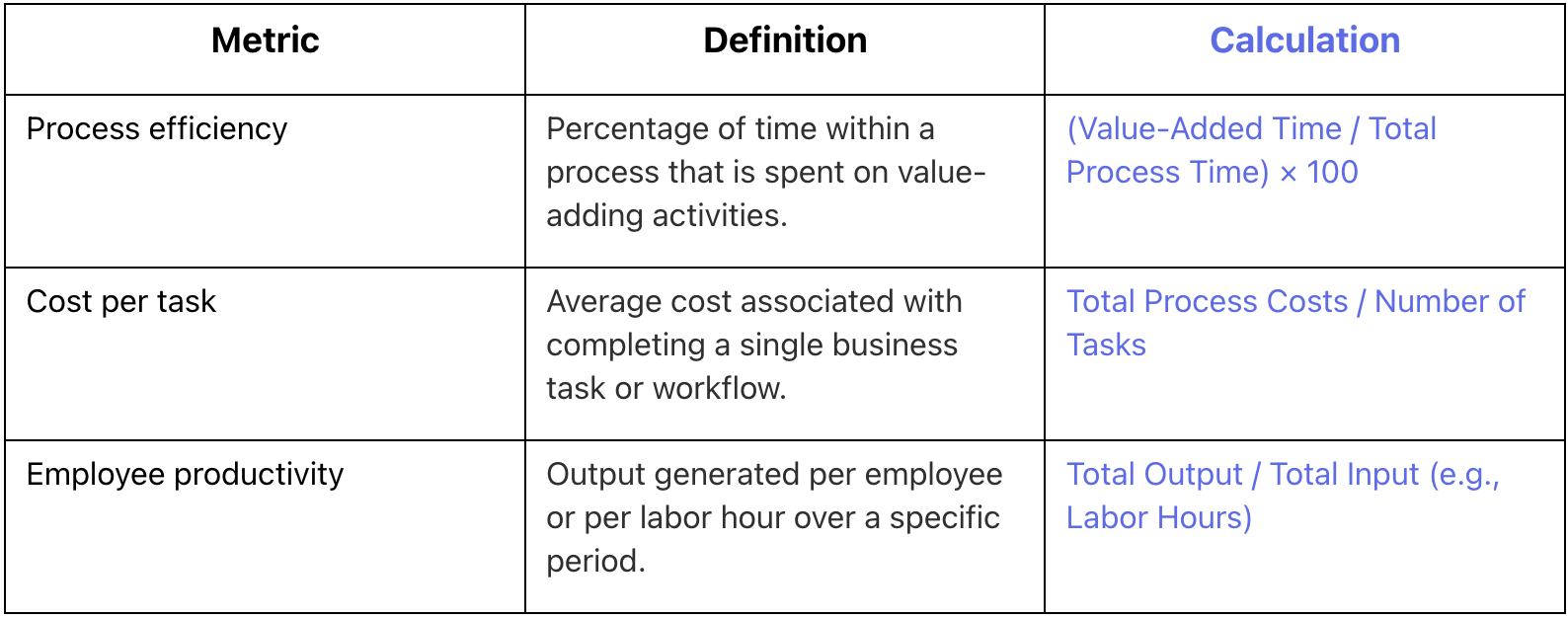
For example: If your goal is to save money → track metrics that show gains in efficiency & productivity.
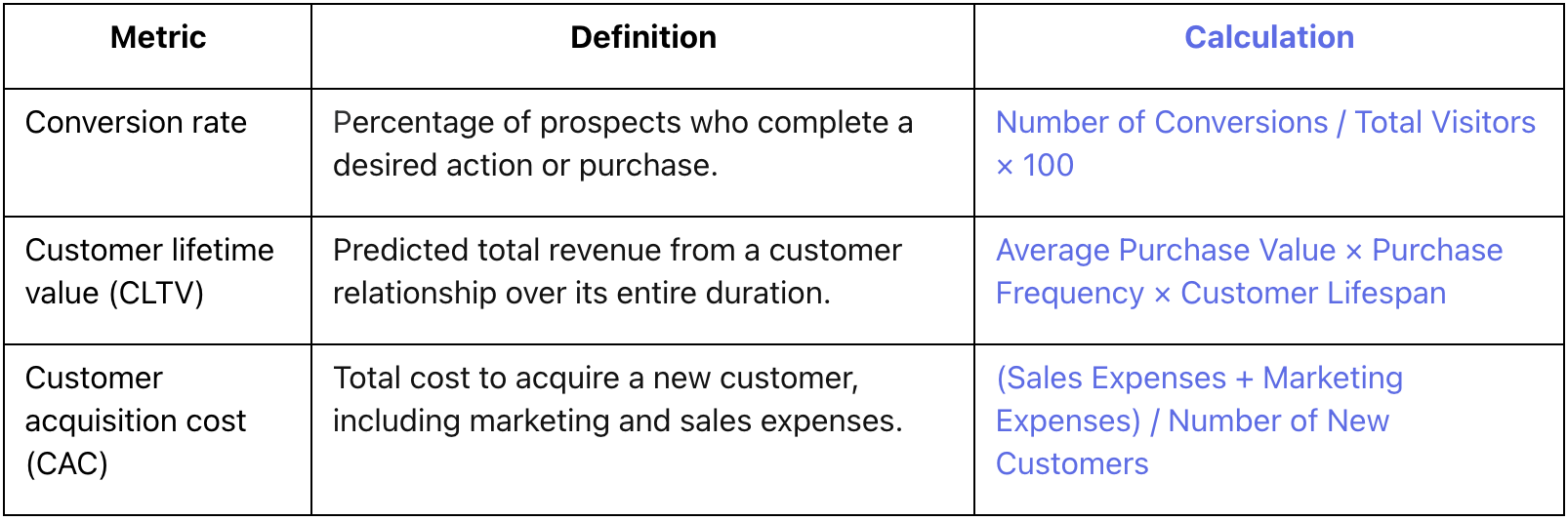
If your goal is to make money → track metrics that tie to revenue and growth.
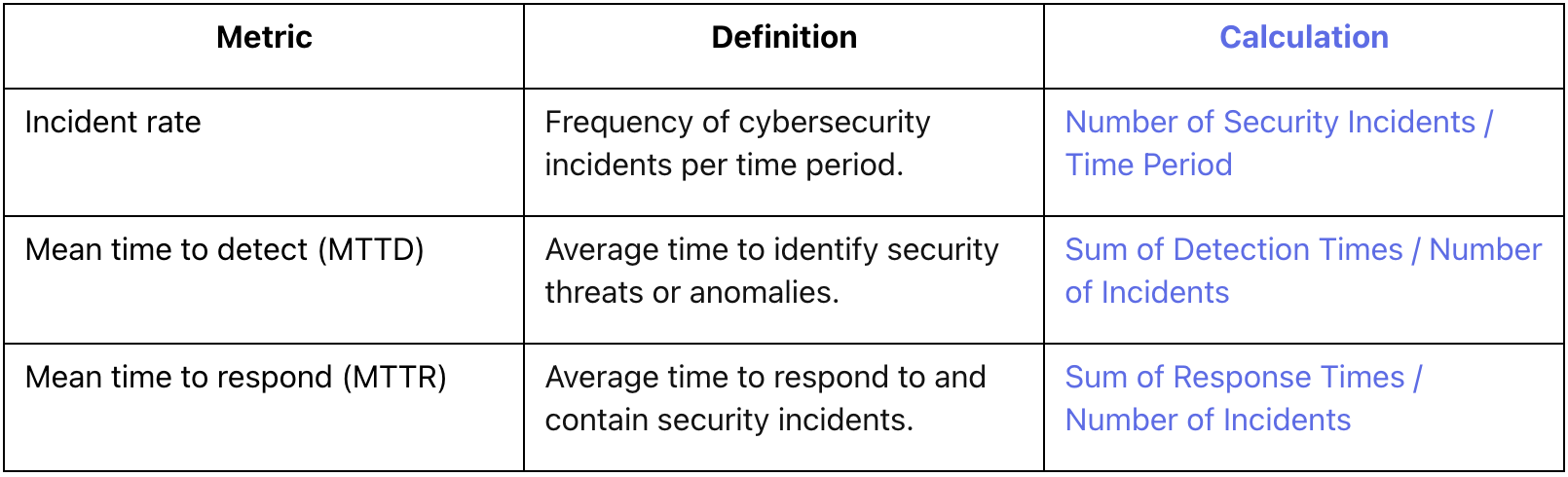
If your goal is to mitigate risk → track metrics that quantify fewer incidents and faster containment.
3. Benchmark the current state
Measure where KPIs sit before AI comes into play. Or, if it’s too late but you have the ability to collect metrics retroactively, now’s the time to do that. Capture time, cost, volume, error rate, and revenue. Use the last eight to 12 weeks to create a stable baseline.
4. Define the future state
Set targets for each KPI that reflect the improvements you expect to see. For example you might anticipate a 25% reduction in time spent on a task, a 10% increase in conversion, or a 40% drop in incident rate.
5. Measure early, measure often
Put data capture in place before launch and track the same KPIs weekly. Measure against the baseline to surface quick wins, build trust, and course correct early.
6. Translate KPIs into financial impact
Convert KPI movement into actual dollars so the whole business understands the impact.
These could include:
- Reduced hours → less labor costs = (hours saved × hourly costs)
- Higher conversion rate → more revenue = (lift × traffic × average order value
- Risk reduction → avoided cost = (incident reduction x average incident cost).
Example: If an AI assistant saves analysts 1,875 hours at $125 per hour, AI yields a $234,375 per year savings.
7. Apply net ROI calculations
Once you’ve had enough time to track significant KPI changes, it’s time to calculate the overall ROI using four metrics:
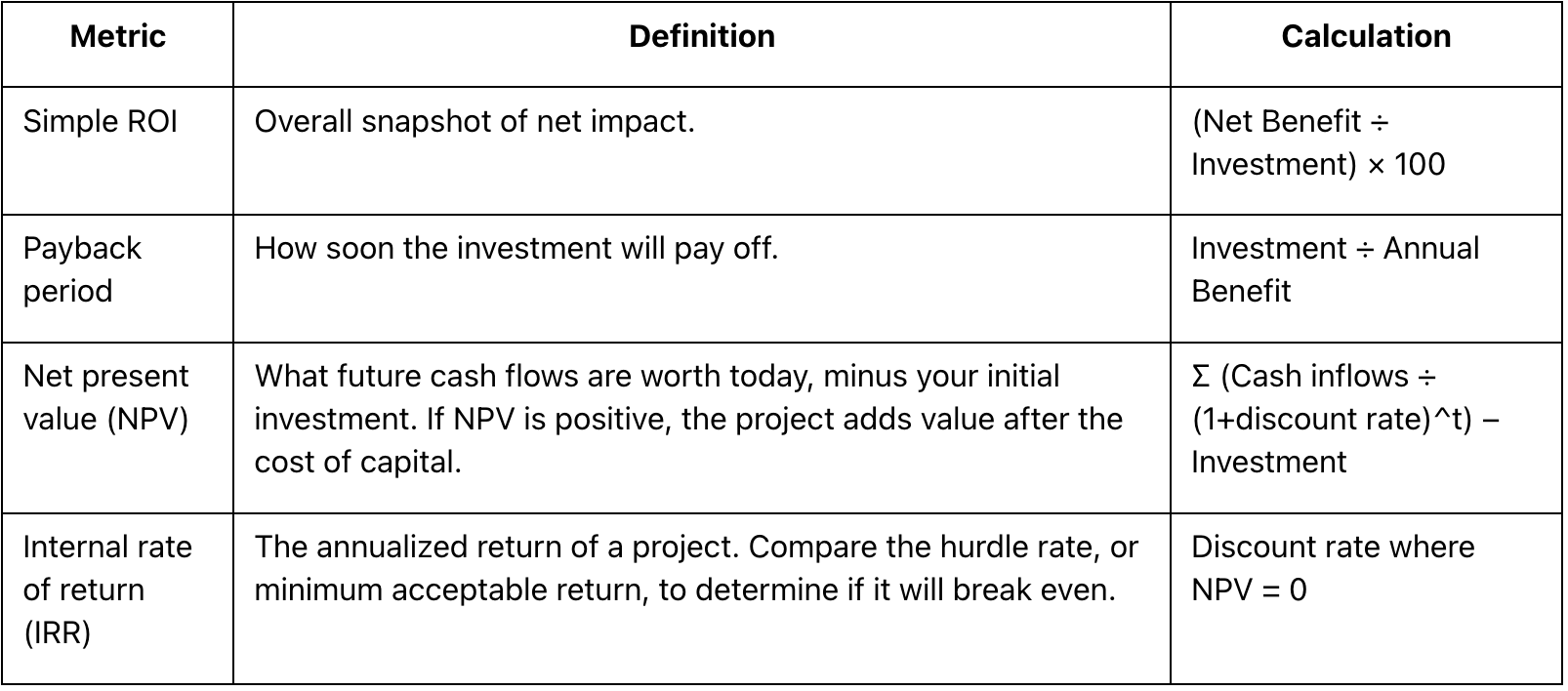
Lead with NPV when talking about creating value. It’s the clearest measure of value created after the cost of capital, and the exact information CFOs use to green-light projects. Add Payback to show speed, IRR to compare to the hurdle rate, and Simple ROI for a quick snapshot.
8. Model sensitivities, assumptions, and risks
Call out adoption risks such as training time and process changes. Model conservative, base, and optimistic cases. Adopt a weekly checkpoint to test if assumptions still hold.
Example: If an AI agent is expected to deliver a 25% efficiency gain as a baseline, a conservative 17.5% efficiency gain would payback in roughly two years. An optimistic 32.5% efficiency gain would put payback at about one year.
Common barriers to achieving AI ROI
There are a few traps enterprises fall into when it comes to AI investments and adoption:
Not thinking beyond efficiency gains
Saving time on tasks doesn’t matter unless those hours are redeployed to create more value for the business.
Fix: Decide where reclaimed hours go and set measurable targets before rolling out AI. That means translating time saved into more output or faster cycles—e.g., +25 proposals/month, +1,500 more tickets resolved/quarter, or cycle time −20%.
Treating AI as one size fits all
Different LLMs are evolving to excel at different tasks. This makes multi-model access key to achieving long-term value and resilience.
Fix: Invest in AI infrastructure that allows you to access different AI models and route each query to the LLM best suited for each task.
Skipping adoption and staff training
You can’t get value out of something people don’t know how to use. Skipping training time leads to low adoption, misuse of agents, and bad AI outputs.
Fix: Include onboarding and ongoing AI training for your teams. Track weekly adoption rate and celebrate quick wins.
Underestimating risk of low-cost tools
Free or low-cost AI tools are tempting, but they can leak internal data and violate policy. Plus it’s likely that those free models are training on your data, whether you agreed or not.
Fix: Work with AI vendors that offer security controls like zero data retention, regional hosting, and no training on your data.
How to ensure your AI investment delivers measurable impact
As exciting as the potential of AI is, flashy features don’t secure budget approval—predictable outcomes do. Measure GenAI ROI by its impact on business outcomes and set a realistic payback window. Let measured results, not opinions, steer the roadmap.
Each verified win should fund the next small bet. With proof in hand, the question shifts from “Should we invest?” to “Where else will this work?”
Curious to learn more about how you can deliver ROI with AI? Book a demo today.
LI Test
LI Test
Share Article:
Related resources.

AI for Efficiency: Where It Delivers Results and Where It Falls Short
March 10, 2026
Blog

From Hype to Value: Unlocking ROI from GenAI
October 22, 2025
Guides