Web Search with Highlights: 95.17% on SimpleQA, 35% Cheaper Than Claude's Built-In Search.


The You.com Web Search with Highlights delivers our best SimpleQA score, 95.17%, a 16.5% relative lift, at no added cost (the same $5 CPM). A separate Braintrust evaluation also found that it cut the total cost of queries 35% versus Claude Sonnet 5's built-in search and 11% versus GPT-5.6 Terra's.
1. What Agents Really Need From a Search Result
Your agent doesn't click links. It reads whatever you hand it, so the payload should carry the answer itself.
Here is a real response to what was nvidia's q2 earnings?, showing the top result from NVIDIA's own press release.
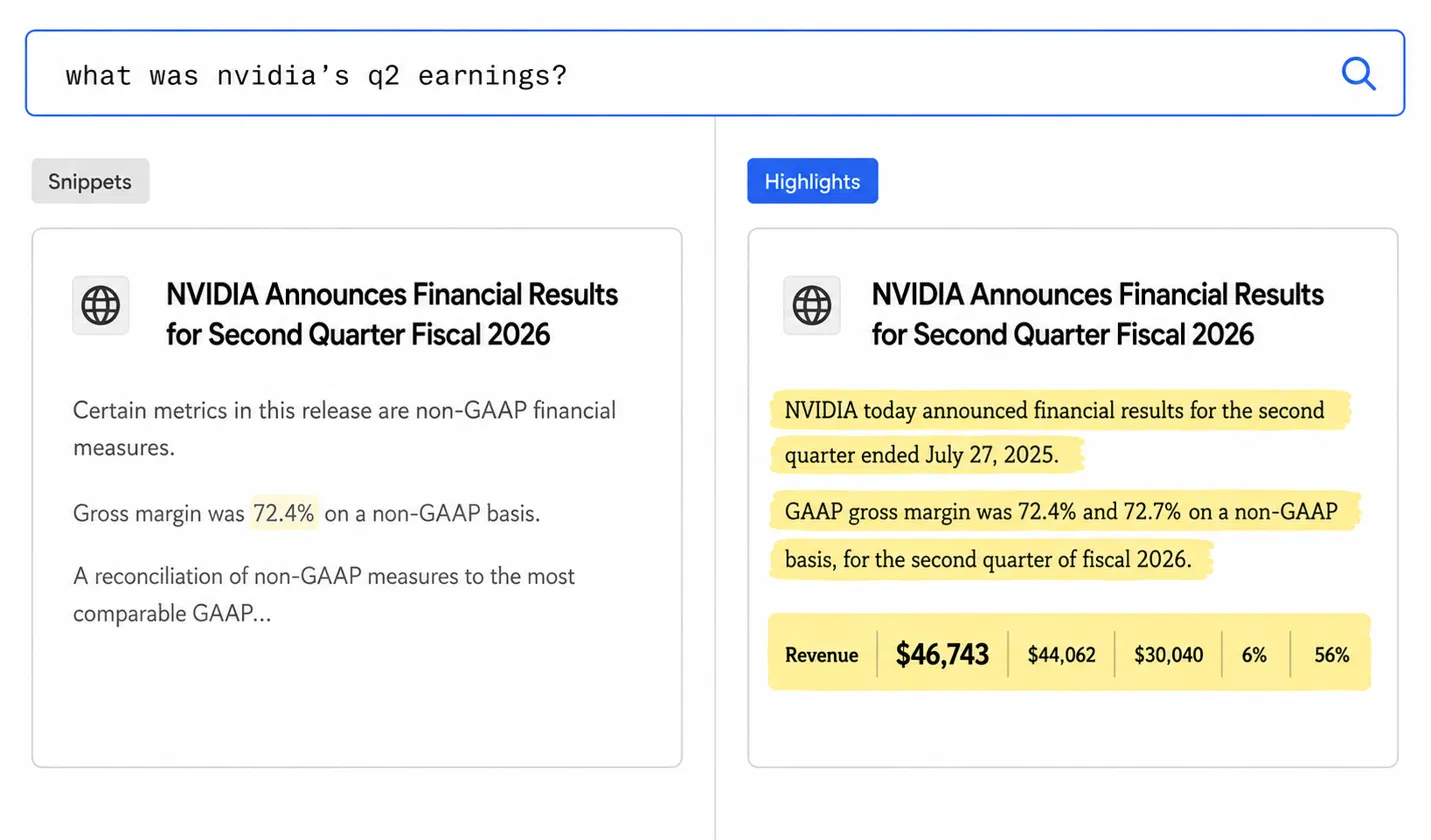
Default, the snippets array:
With extraction_mode: "highlights", the contents.highlights array:
Run it against your own key and diff the two responses:
Drop extraction from the body and run it again. That's the whole difference.
2. How Highlights Works
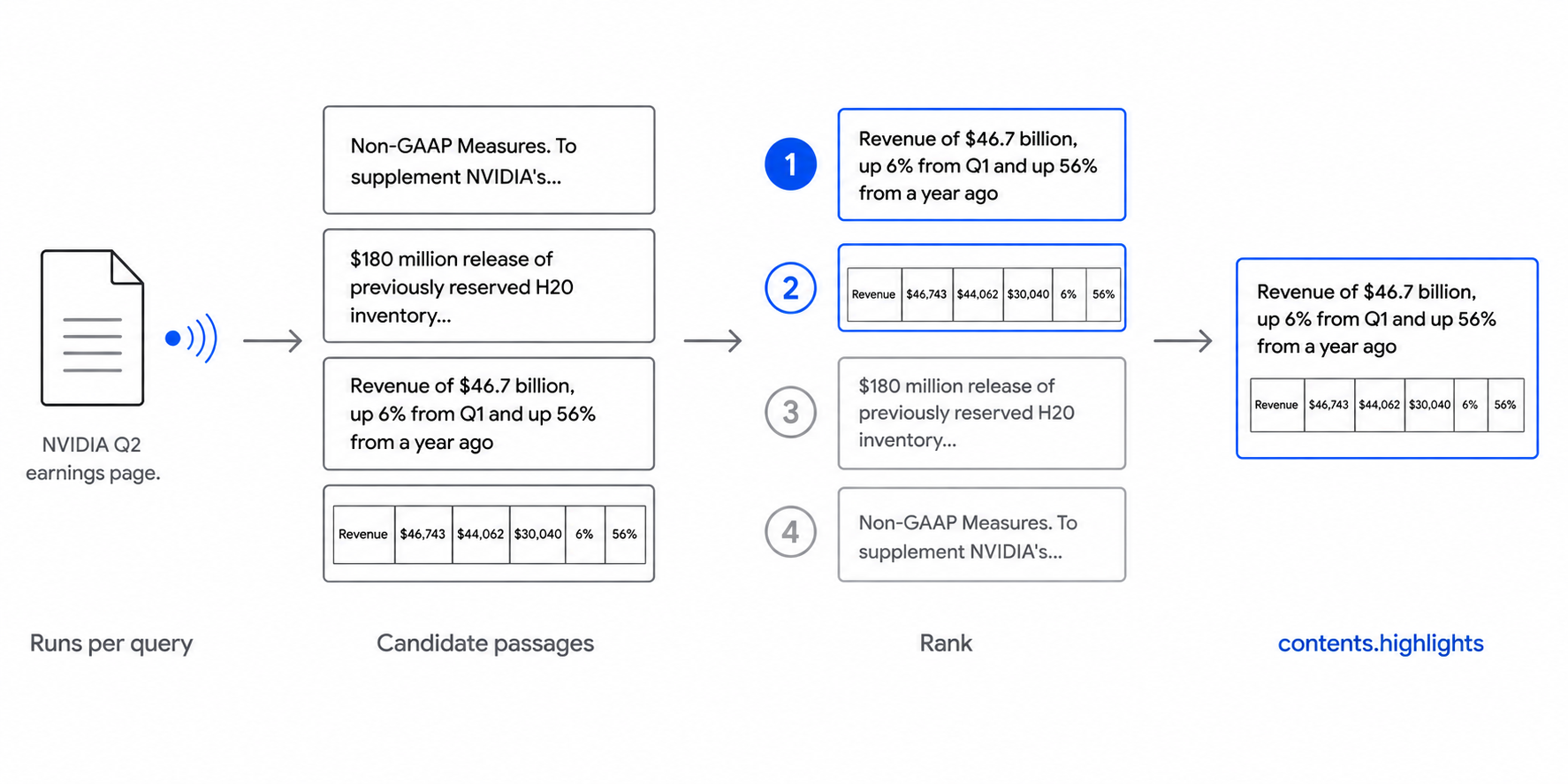
You.com Web Search with Highlights runs per request. Each query triggers a fresh extraction pass against the page, so passages are selected against what was actually asked. That's the NVIDIA page from Section 1: the revenue and Data Center figures survived because they answered the question, and the H20 inventory and non-GAAP boilerplate didn't, because they didn't.
Extraction works by selection. A model identifies which spans of text on the page already answer the query and returns those spans verbatim, with any numbers, dates, or figures exactly as they appeared in the source.
Tables return with their headers intact. Code blocks keep their original formatting and language. Sentences from the same section that both matter get merged into a single passage.
Candidate passages are ranked, and the highest-ranked ones are returned first. This means a short, relevant span still surfaces even in a document where it’s a small fraction of the total text.
3. Highlights Improves Accuracy
We ran three benchmarks against all three extraction modes.
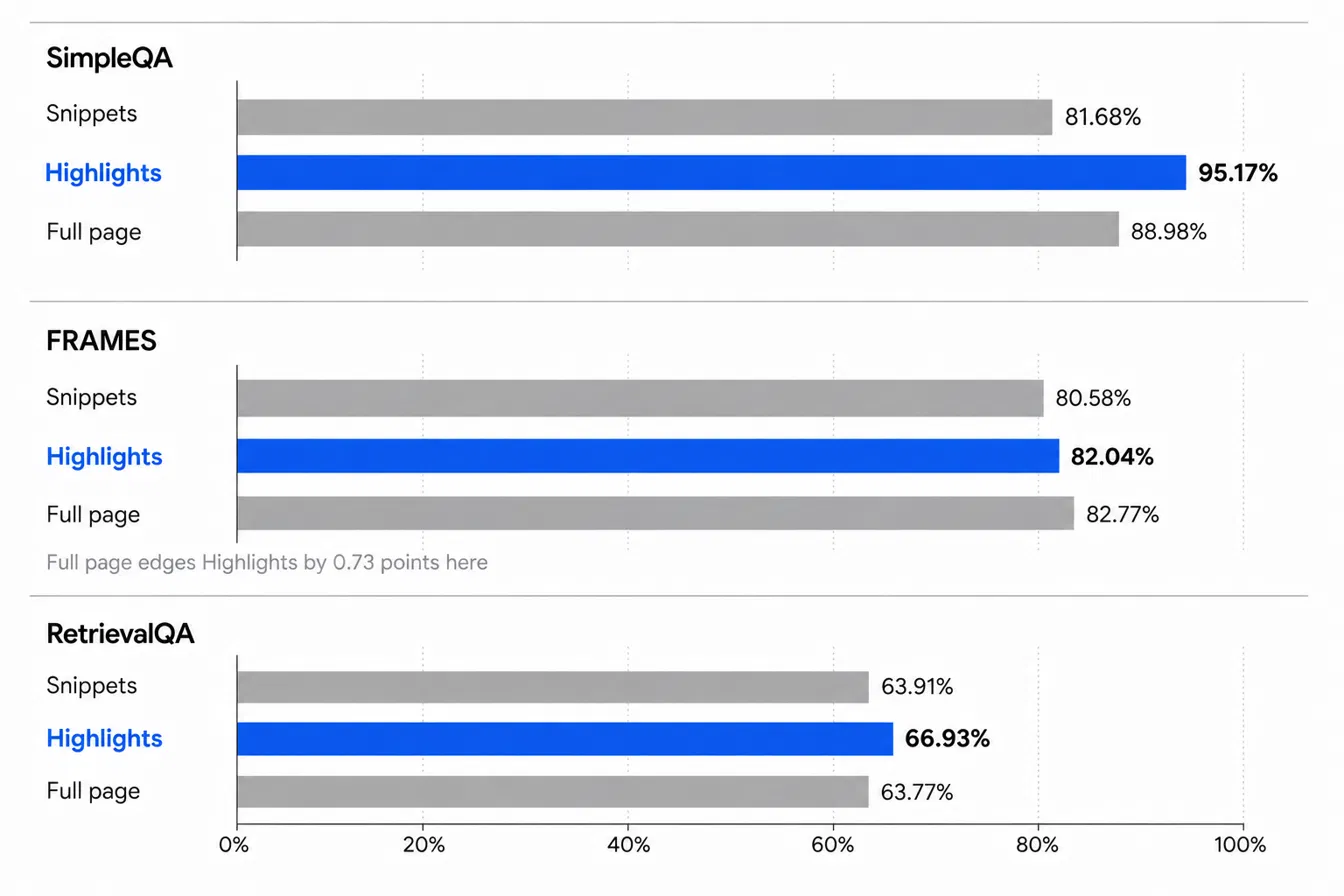
You.com Web Search with Highlights leads on SimpleQA and RetrievalQA, the two benchmarks built around single-fact lookups rather than multi-hop reasoning. On FRAMES, full-page extraction edges it by 0.73 points, inside the run-to-run variance we see on that benchmark.
That accuracy gain isn't free: cost per question rises about 11% versus Snippets, since Highlights sends more text to the answering model. But cost per correct answer, which divides cost by accuracy, still comes out about 5% lower — the extra spend buys more than it costs.
Against the field, that accuracy holds up, and it comes with a latency advantage the table above doesn't show. On SimpleQA, three systems clear 95%. For each competitor we're showing their best-performing configuration, not necessarily the one most comparable to Highlights, so the comparison favors them on setup.
Accuracy is a wash, within 0.30 points across all three. Latency isn't: You.com answers in roughly a third of the time it takes Parallel, and about half the time Exa takes.
4. Highlights Cuts Total Cost Across Every Tested Model, Up to 35%
Braintrust, as part of an independent evaluation, ran You.com Web Search with Highlights against the search tools bundled into the OpenAI and Anthropic APIs, on 1,329 questions, with cost including inference and search.
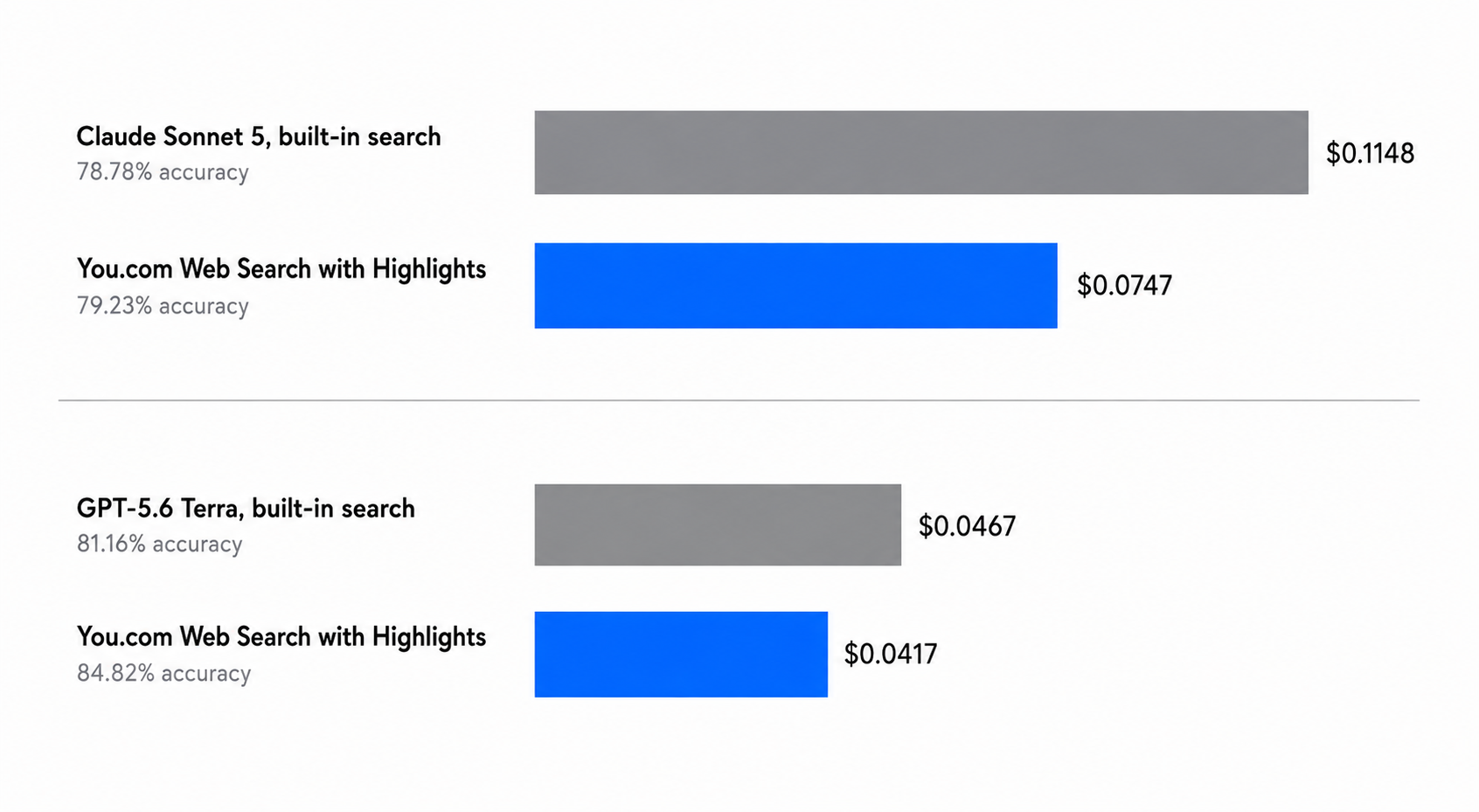
Claude Sonnet 5 costs $0.0747 per question with Highlights, against $0.1148 for its own built-in search — 35% less, at slightly higher accuracy (79.23% vs. 78.78%) and 1.26 seconds faster.
GPT-5.6 Terra costs $0.0417 per question against $0.0467 built-in, 11% less, and 3.66 points more accurate.
Cost per correct answer, which divides cost by accuracy, drops 35% for Claude and 15% for GPT, since Highlights is also getting more of the questions right on the same or lower spend.
Cost per correct answer tells you what a wrong answer costs. It doesn't tell you why one happened.
5. Unbundled Web Search Provides Better Observability Than OpenAI and Claude’s Built-in Search
Here's why. Built-in search hands back the queries it ran and the pages it cited. It does not hand back the passages the model reads, so a wrong answer arrives with no way to see which step produced it.
Braintrust's evaluation included a question asking how many service games Carlos Alcaraz lost across two tournament runs combined, requiring the model to add two separate numbers together.
The You.com configuration returned one passage establishing the first value at 24 and another establishing the second at 22, and the model added them to answer 46. The runs that missed never surfaced a passage supporting 24, used 22 for both values, and answered 44.
Every run did the arithmetic correctly, and you can only know that because the passages are in the trace. See the full example in Braintrust's writeup →
6. When Not to Use Highlights
Highlights adds about 160ms over Snippets on single-shot lookups. Under a hard latency budget on simple Q&A questions, Snippets remain the right default and they haven't changed.
For pages that move faster than an index refreshes, extraction_mode: "full_page" fetches live rather than serving from cache. FRAMES is the benchmark where that shows up: its questions are multi-hop, meaning the agent needs a wider slice of context to chain facts across several pages, and full page's larger payload has room for that where a handful of tightly-scoped passages doesn't. Full page beats Highlights there by 0.73 points.
7. Ship It
You've seen the payload, the accuracy, the cost, and the trace. The only thing left is to run it against a query that matters to you.
It's one field.
Passages arrive in contents.highlights. Nothing else about your integration changes.
New accounts get $100 in credits, which covers every benchmark in this post end to end. The harness that produced these numbers is public, so point it at your own questions and see for yourself:
LI Test
LI Test
Share Article:
Related resources.
.jpg)
Knowledge: Live Stock Prices, Sports, Crypto, And More. Now In Web Search. Same $5 CPM.
September 23, 2026
Product Updates

The n8n You.com Node Now Has 7 Operations, Including Background Research
September 10, 2026
Product Updates
Introducing the You.com Answer API: Grounded, Cited Answers Powered by Real-Time Web Search
August 5, 2026
Product Updates

The You.com Research API Frontier Tier Reaches a New Level of State-of-the-Art Performance
July 22, 2026
Product Updates
The AI API Stack Has a Research Problem
June 30, 2026
Product Updates