Knowledge: Live Stock Prices, Sports, Crypto, And More. Now In Web Search. Same $5 CPM.
.png)
.jpg)
Ask an agent what Nvidia is trading at right now, or what Bitcoin did in the last hour. Ask what tomorrow's high is in Denver, how many races Denny Hamlin has won this NASCAR season, or what the median apartment rent is in Tucson.
A human finds the right answer in seconds. Why can't your agent?
We ran 155 questions like these against every major web search API, using the public VerticalRTK benchmark. Details and methodology at GitHub.

Web Search Has A Ceiling Around 65%
Web search does enormous work. On VerticalRTK, it moves GPT 5.6 Luna from 14.8% to the mid 60s, and every major provider delivers it. That is the single largest improvement available on this question set.
Then it stops. Four independent APIs, from four different companies, all cluster within 1.3 points of each other between 63.9% and 65.2%. Spending longer in retrieval does not help either. The slowest endpoint takes 4.4s and gains 0.7 points of accuracy over the fastest.
Our own web search sits in that cluster. It is the fastest web search API we measured at 0.60s and it ties for second on accuracy. Yet it still cannot answer 35.5% of the questions in the benchmark. Traditional web search hits a ceiling defined by what the crawlable web contains.
What limits an agent here is whether the answer is on the web at all. Most of what changes by the second never makes it to a crawlable page in a usable form. Live prices sit behind exchange feeds, prediction market odds live in orderbooks, federal contract obligations sit in a database. A crawler can find a news story about yesterday's Fed decision. It cannot find this morning's rate.
How You.com Knowledge Breaks The Ceiling
Those feeds and databases can be licensed. And we added them to the search call you already make, adding just one parameter: "knowledge": "core"
Same endpoint, no additional charge over the You.com Web Search API's $5 CPM. Our web search alone answers 64.5% of these questions at 0.60s. Turn the parameter on and it answers 84.2% at 0.74s.
That is trading 19.7 points of accuracy for 140ms of latency. The latency stays low because nothing runs in sequence. An agent's request hits the web index and the licensed feeds in parallel, and we only return knowledge data if it exceeds our internal confidence thresholds.
An Example: NASA Federal Contract Outlays
Nineteen points is an average across 155 questions. It is easier to see what it means on one question in specific:
How much did NASA pay out in federal contract outlays in FY2025?
The answer is $9,363,220,226. Every web search API we tested, including our own, returned something different, ranging from $19.8 billion to $28.8 billion.
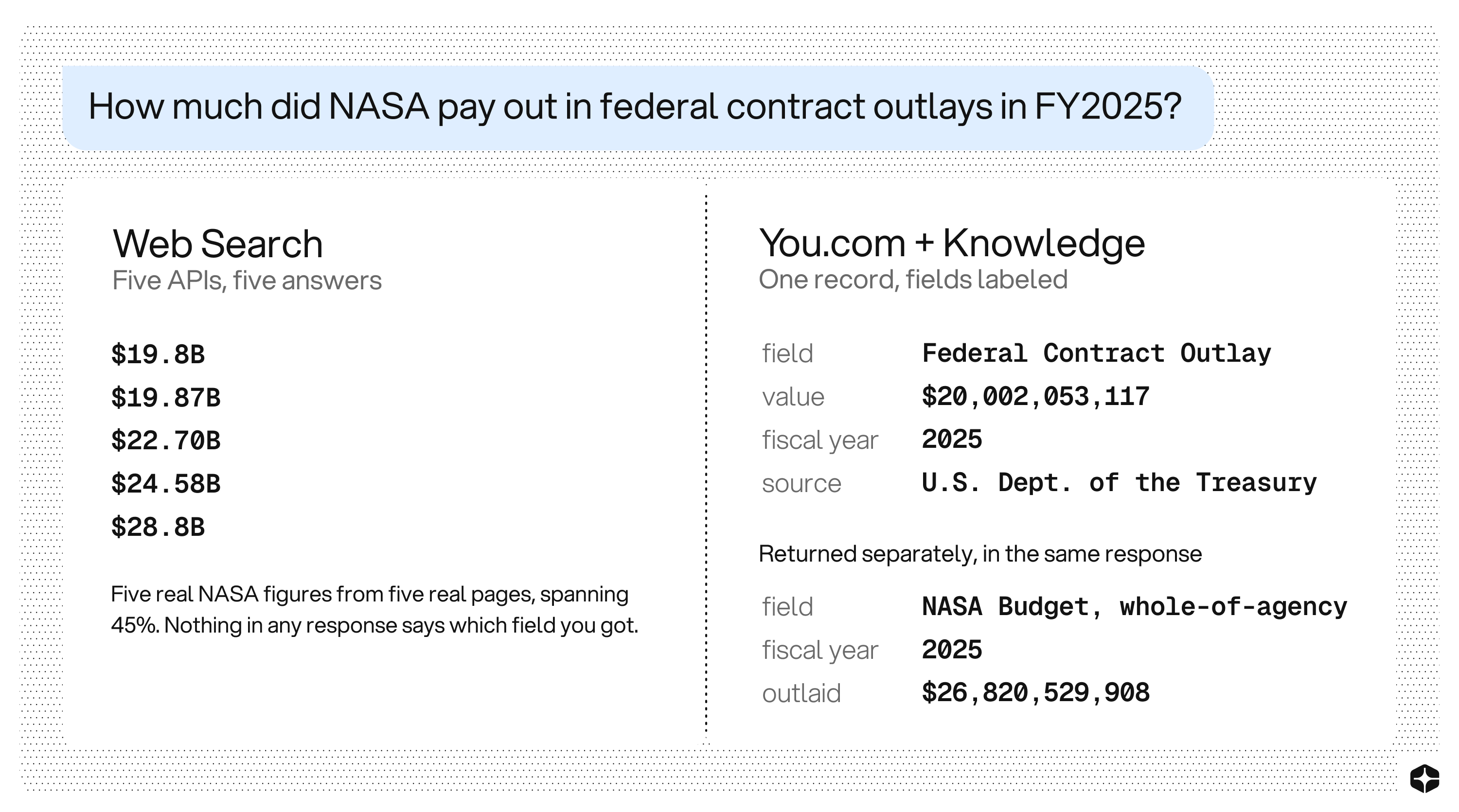
Nothing was hallucinated. Every one of those is a real NASA figure from a real page. Some are a different line item entirely, and the closest is off by two hundred million dollars. A page carrying a dozen spending figures leaves the model to work out which one the question asked for.
Knowledge reads the record instead. The figure arrives labeled with its field name, its fiscal year, and its source, so there is nothing left to infer.
Here is the record, trimmed for readability:
FY2025 closed on September 30, 2025 so this is not live data. Some things change too fast to crawl, and some things were never a page to begin with. Knowledge covers both types of data.
Try the query above in our playground.
From Federal Contracts To The Weather In Boise
Knowledge draws on hundreds of authoritative sources. Some we license directly. Others come through technical partnerships, with Tako and others. You get all of it through one parameter.
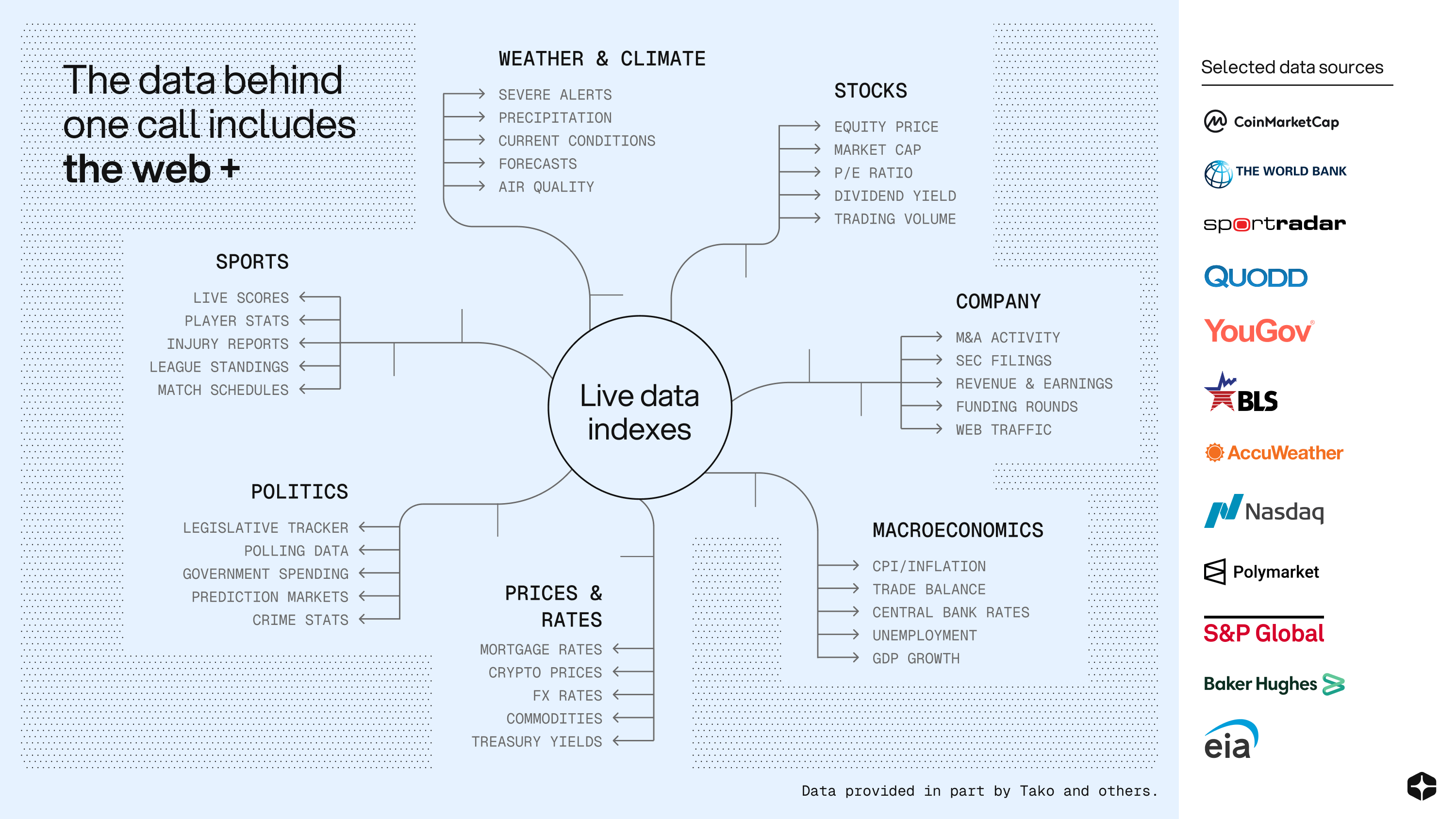
Here are a few examples of data your agents can now access:
- "What's the Big Mac Index for Japan versus the US?" (The Economist)
- "What's Nvidia's stock price?" (Xignite / S&P Global)
- "What's the weather in Boise, Idaho?" (AccuWeather)
- "What's Bitcoin's price right now?" (CoinMarketCap)
Run any of these yourself: ydc-knowledge-samples on GitHub.
And we're adding new sources all the time. Interested in partnering with us as a data provider? Email us: [email protected]
One Parameter Instead Of Five Vendor Negotiations
You could integrate this data yourself, and teams do. Say your agent needs Nike's performance in Europe. The stock trades on Nasdaq. Earnings estimates are aggregated by S&P Global. Web traffic comes from Semrush, FX rates from QUODD, and filed revenue and analyst forecasts each sit with a different specialist again. Your report still has gaps. Ask about weather or a game score instead and it is a different set of providers entirely.
Identifying them is the easy part. Each one means a steep upfront commitment, a bespoke contract negotiation, and integration work before it answers anything. Then you write the code that stitches their answers together. Multiply that across every source you need and the cost compounds before your product has launched.
The Knowledge parameter replaces all of that complexity.
Knowledge also removes the routing layer. An agent taking arbitrary questions cannot know whether the next one is a stock price, a weather forecast, or a federal contract total, so anything requiring you to pick a source up front means building a router that guesses before it knows. Knowledge stays on and picks at query time.
When Not To Use Knowledge
Knowledge adds roughly 140ms to a web search call.
If you're confident your workload never touches off-web or real-time data, or you're latency sensitive, don't turn it on by default. An agent that only ever needs article content is paying 140ms for a path that won't return anything.
The case for leaving it on is when you can't predict the question. If the next one might be a stock price, a forecast, or a rate, checking costs you 140ms.
Try It Now
Add the "knowledge": "core" parameter to the web search call you're already making.
Full parameter reference: you.com/docs/api-reference/search/v1-search.
Five runnable examples, plus the full coverage table and benchmark available on GitHub.
Seven categories, hundreds of sources, and we've only shown you a handful. Build something with it and show us.
Quote-post our announcement on X with your Knowledge-powered example, demo, use case, or GitHub repo, and tag @YouDotCom so we can find it.

We'll highlight standout projects across our developer community, social channels, and newsletter.
LI Test
LI Test
Share Article:
Related resources.

The n8n You.com Node Now Has 7 Operations, Including Background Research
September 10, 2026
Product Updates

Web Search with Highlights: 95.17% on SimpleQA, 35% Cheaper Than Claude's Built-In Search.
September 1, 2026
Product Updates
Introducing the You.com Answer API: Grounded, Cited Answers Powered by Real-Time Web Search
August 5, 2026
Product Updates

The You.com Research API Frontier Tier Reaches a New Level of State-of-the-Art Performance
July 22, 2026
Product Updates
The AI API Stack Has a Research Problem
June 30, 2026
Product Updates