TLDR: Two new parameters—source_control and output_schema—give developers deterministic control over where the research agent looks and what it returns.
From Capability to Controllability
In February, we launched the You.com Research API with state-of-the-art (SOTA) results on DeepSearchQA: 83.67% accuracy, 93.16% F1, and a single-agent architecture that scales to 1,000 reasoning turns and 10 million tokens per query.
Teams building systems with this API asked for two more things: the ability to bind the agent to defensible sources, and the ability to receive structured output they could pipe directly into downstream workflows without brittle parsing.
Our latest version of the ResearchAPI delivers both.
What's New, at a Glance
| Parameter |
What it Does |
Why it Matters |
| source_control.include_domains |
Restricts the agent to a list of up to 500 trusted domains for both search and browsing |
Scope research to authoritative, pre‑approved sources |
| source_control.exclude_domains |
Blocks up to 500 domains from search results and agent browsing |
Strip out low‑signal or blocked content (mutually exclusive with include_domains) |
| source_control.freshness |
Filters results by recency — day, week, month, year, or a custom YYYY‑MM‑DD to YYYY‑MM‑DD range |
Constrain to time‑bounded windows for news, compliance, and market tracking |
| source_control.country |
Focuses results geographically via ISO 3166‑1 alpha‑2 codes (US, GB, DE, …) |
Jurisdiction‑aware research and locale‑specific synthesis |
| output_schema |
Accepts a JSON Schema definition; the API returns structured JSON conforming to it |
Predictable typed output for pipelines, UIs, analytics, and downstream agents |
Both parameters are live in production. output_schema works with research_effort tiers standard, deep, and exhaustive, and composes with source_control in a single request.
Source Control: Bind the Agent, Not the Results
The source_control object exerts constraints at the harness level, not at the post-filter. The agent still plans, searches, retrieves, cross-references, and composes its answer, and does so inside the sandbox you define. You are not filtering results after the fact. You are telling the agent where it is allowed to operate, resulting in more refined results.
A few production patterns this opens up:
| Use Case |
Configuration |
| Regulated enterprise research drawing only from primary authoritative sources |
include_domains set to regulators, SEC filings, and internal‑approved publishers |
| Competitive‑intelligence workflow with aggregators and content farms excluded |
exclude_domains list of known low‑signal sources |
| News synthesis agent constrained to a 24‑hour window in a specific market |
freshness: "day" + country: "JP" |
| EU product‑compliance research scoped to German regulators |
country: "DE" + include_domains allowlist of EU regulators |
The 500-domain ceiling on both allowlist and blocklist provides flexibility without turning configuration into a data-management problem of its own. include_domains and exclude_domains are mutually exclusive per request—you are either telling the agent exactly where to go or where not to look.
Output Schema: Stop Parsing, Start Consuming
The output_schema parameter takes a JSON Schema definition and forces the API to return structured JSON that conforms to it. For example, free-form text is excellent for a chat interface, but it’s a liability in a production pipeline where every downstream consumer has to parse, validate, and repair its way through prose.
Three patterns where this earns its keep immediately:
| Pattern |
What it Replaces |
| Typed entity extraction (company, person, location, date, URL) |
A second LLM call to post-process, or a fragile regex |
|
Fixed-section research briefs (
summary,
key_findings,
risks,
sources
)
|
Prompt-fragile parsing that breaks when the model rephrases headings |
| Numeric, enum, or boolean fields for analytics and routing |
Post-hoc type coercion and validation logic |
The agent enforces the schema as it composes its answer, not at the end. That means the output contract shapes the research loop itself—the agent knows what fields it owes you and allocates effort accordingly.
One Request: Scoped and Structured
Here is what a scoped, structured call looks like in practice. An EU AI Act compliance delta scoped to three authoritative sources, the last 90 days, and returned as a typed object ready to render or route.
Code Example
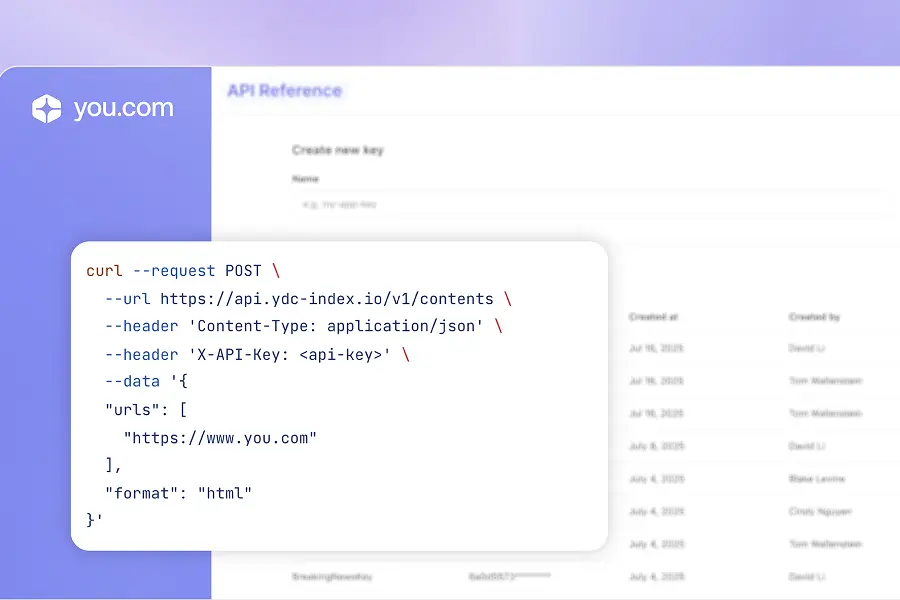
curl --request POST \
  --url https://api.you.com/v1/research \
  --header 'Content-Type: application/json' \
  --header 'X-API-Key: <API_KEY>' \
  --data '{
    "input": "Summarize material changes in EU AI Act compliance obligations for foundation model providers in the last 90 days.",
    "research_effort": "deep",
    "source_control": {
      "include_domains": [
        "eur-lex.europa.eu",
        "digital-strategy.ec.europa.eu",
        "edpb.europa.eu"
      ],
      "freshness": "2026-01-21to2026-04-21",
      "country": "DE"
    },
    "output_schema": {
      "type": "object",
      "properties": {
        "summary": { "type": "string" },
        "changes": {
          "type": "array",
          "items": {
            "type": "object",
            "properties": {
              "date":             { "type": "string", "format": "date" },
              "obligation":       { "type": "string" },
              "affected_parties": { "type": "array", "items": { "type": "string" } },
              "source_url":       { "type": "string", "format": "uri" }
            },
            "required": ["date", "obligation", "affected_parties", "source_url"],
            "additionalProperties": false
          }
        }
      },
      "required": ["summary", "changes"],
      "additionalProperties": false
    }
  }'
One call. Three authoritative EU domains. Ninety-day window. Typed output.
Available Today
Full documentation, schema rules, and additional code examples are live at docs.you.com/research/overview. Both parameters are supported with the API key you already have—no new tier, no waitlist.
If you're binding an agent to a specific corpus, piping structured output into a downstream system, or running scoped research inside a production compliance, market-intelligence, or analytics workflow, we want to see it. The next round of improvements is shaped by the usage patterns we see. Thank you for using our Research API.
.png)

.webp)