How to Evaluate AI Search in the Agentic Era: A Sneak Peek

LI Test
LI Test
The rise of large language models (LLMs) has made it clear that even the most sophisticated reasoning engines are only as good as the information they retrieve. If your AI’s search is weak, you’re courting hallucinations, stale information, and frustrating user experiences. But if your search is too slow or unreliable, even the smartest agent becomes unusable.
At You.com, we’ve spent years building, benchmarking, and refining the leading AI search infrastructure. Our tech is trusted by enterprises and developers for its accuracy, speed, and real-time capabilities. But in an era of hype and marketing claims, how can you really know which AI search provider is best for your needs—or even if upgrading is worth the cost?
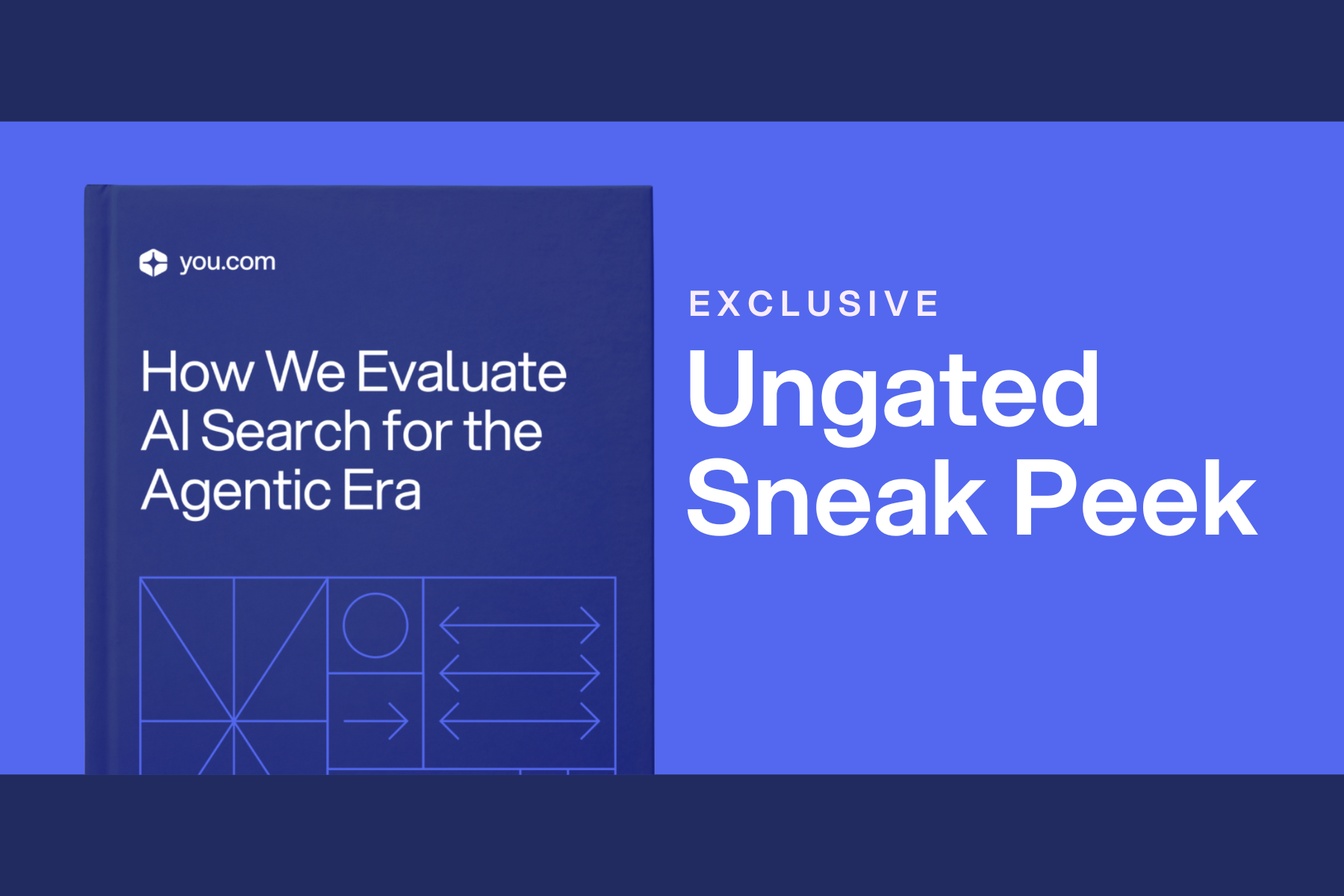
That’s the central question tackled in our latest whitepaper, “How We Evaluate AI Search for the Agentic Era.”
%20(3000%20x%201000%20px)%20(1).png)
Below, we offer a preview of the rigorous, transparent, and innovative methodology we use—one that you can apply whether you’re comparing vendors or justifying a migration to your stakeholders. If you care about making data-driven decisions for your AI stack, this is a must-read.
Why Is Search Evaluation So Hard?
Most teams, even those building cutting-edge AI, fall into the same trap: run a handful of test queries, eyeball the results, and pick whatever “looks good.” It’s a recipe for trouble. You’ll soon discover your agent hallucinating, returning outdated info, or failing under real-world workloads. That’s because search evaluation is fundamentally challenging—here’s why:
1. The Golden Set Problem
Do you have a curated, representative set of queries and ground truth answers? For most, the answer is no. Relevance is subjective and context-dependent, and what’s “right” changes over time.
2. The Scale Problem
Evaluating search isn’t just about a few test cases. It means judging billions of potential documents across thousands of queries. Human labeling at this scale? Nearly impossible.
3. The False Negative Problem
If your ground truth is incomplete, great results might go unrecognized and your evaluation will penalize the very providers that surface them.
4. The Distribution Mismatch Problem
Standard benchmarks often don’t reflect your actual use case. If you serve developers, doctors, or finance pros, a generic dataset from 2019 won’t predict real-world performance.
The whitepaper lays out these pain points in detail—and, more importantly, shows how to overcome them with a multi-layered, statistically rigorous approach.
The Four-Phase Framework for Search Evaluation
Here’s a taste of the methodology we use internally and recommend for anyone serious about AI search.
Phase 1: Define the Problem & Success Criteria
Before you measure anything, ask: What does “good” mean for your business? Is it freshness, domain authority, specific query types, or something else? Without clear criteria, you risk moving goalposts and making sub-optimal decisions.
Phase 2: Data Collection—Build Your Golden Set
The golden set isn’t just test data—it’s your organization’s consensus on quality. The guide offers step-by-step instructions on how to curate a set of queries and answers that truly reflect your users’ needs, and how to avoid common pitfalls like inconsistent labeling.
If you can’t build a golden set right away, the whitepaper also outlines how to leverage established benchmarks (like SimpleQA, FRAMES, or domain-specific datasets) as a starting point.
Phase 3: Run Queries & Collect Results
Run your full query set across all providers, capturing structured results: position, title, snippet, URL, timestamp. For agentic or RAG (retrieval-augmented generation) scenarios, pass every provider’s results through the same LLM and prompt—so you’re really testing search, not answer synthesis.
The guide underscores the importance of parallel runs, logging, and storing both raw and synthesized results for robust, apples-to-apples comparisons.
Phase 4: Evaluation & Scoring
Do you have ground truth? If not (the common case), use LLM-as-judge with human validation. The whitepaper details how to design prompts, measure LLM-human agreement, and iterate until your judgments are reliable. If you do have labeled answers, you can use classical IR metrics (Precision@K, NDCG, MRR) and more modern LLM-based approaches.
Crucially, You.com’s framework doesn’t stop at “accuracy.” It emphasizes statistical rigor—reporting confidence intervals, measuring evaluation stability (with ICC), and ensuring that any claimed differences between providers are real, not artifacts of random LLM behavior.
Why This Approach Is Different
Most AI search evaluations rely on cherry-picked examples or single-run metrics. Our framework is built for reproducibility, transparency, and true decision-making confidence. Here’s what sets it apart:
- Domain-Specific Datasets: Custom golden sets and industry benchmarks ensure evaluations match your real-world scenarios.
- Reproducible Infrastructure: Every improvement at You.com is evaluated with structured, documented processes—so we can isolate and fix issues at the retrieval, snippet, or synthesis stage.
- Dual-Route Measurement: We measure both raw search quality and end-to-end answer accuracy, ensuring our platform excels as a standalone API and as the retrieval layer for agents.
- Statistical Transparency: Our published research on evaluation stability (e.g., ICC, variance decomposition) means you get meaningful, trustworthy results—not just a number.
Ready to Go Deeper?
This blog post only scratches the surface. The full whitepaper offers practical templates, validation protocols, prompt examples, and actionable checklists—along with real benchmark results from You.com’s own infrastructure.
Whether you’re building developer tools, finance agents, or next-gen AI assistants, this guide will help you make search decisions based on evidence, not guesswork.
Want to see the full methodology and start running world-class search evaluations?
LI Test
LI Test
Share Article:
Related resources.

The You.com Web Search Eval Harness: Benchmark Any Web Search Provider Yourself
April 21, 2026
Blog

Extreme Single-Agent Inference Scaling for Agentic Search: Achieving SOTA on DeepSearchQA
April 20, 2026
Blog
.png)
Best Web Search APIs for AI Agents: What to Test Before You Commit
April 13, 2026
Blog
Why Your AI Search Evaluation Is Probably Wrong (And How to Fix It)
March 10, 2026
News & Press
Randomness in AI Benchmarks: What Makes an Eval Trustworthy?
December 19, 2025
Blog
All resources.
Browse our complete collection of tools, guides, and expert insights — helping your team turn AI into ROI.
.png)
You.com Web Intelligence Is Now Available in MindStudio’s Remy Apps
June 4, 2026
Blog

Context Window: Meaning and Optimization Tips
May 26, 2026
Blog
.png)
How APIs Became the Connective Tissue of LLMs
May 20, 2026
Blog

Simple Abstractions, Dense Payloads: Tool Design for Agentic Search
May 18, 2026
Blog
Introducing the You.com Finance Research API: Agentic Research, No Infra Required
May 14, 2026
Blog
Same LLM, Better Web Search, Better Outcome
May 7, 2026
Blog
What Is Semi Structured Data: A Developer's Guide
May 4, 2026
Blog
.png)
Context Rot Is Quietly Breaking Your API Integrations
May 1, 2026
Blog