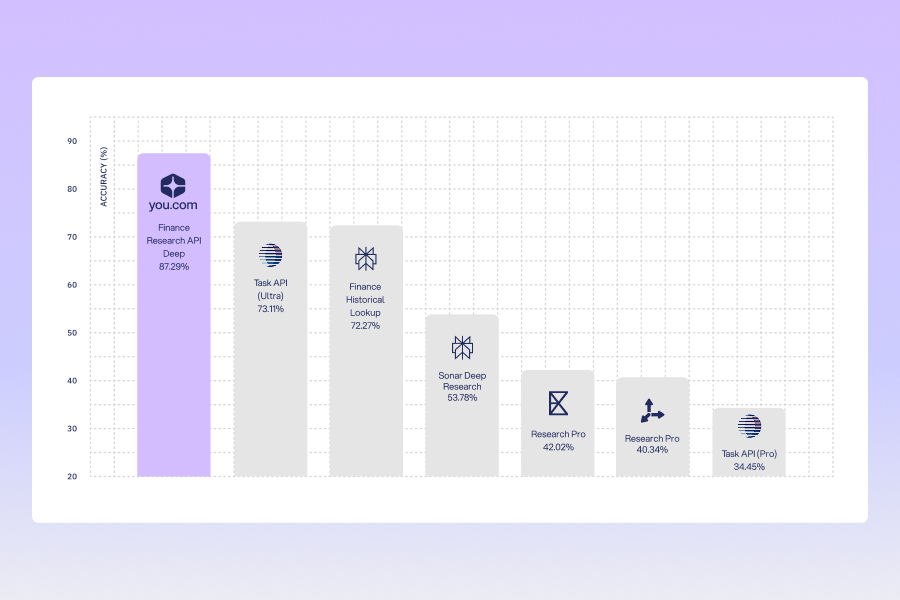
TLDR: The You.com Research API was updated this month, resulting in impressive new benchmark results. The Frontier tier—the deepest research setting, built for long-horizon, many-source investigations—now hits roughly 87% on DeepSearchQA (up from ~84% on v1) and sets a new state-of-the-art benchmark on FinSearchComp. Alongside it, improvements to the asynchronous execution mode support longer-running research.
When a 300-Second Research Job Dies at Second 297
Anyone who has run a deep research agent against the open web has experienced this hurdle. The job kicks off, the planner fans out across dozens of sources, the agent cross-references, and somewhere past the four-minute mark, the socket drops. A longer connection over that window is fragile by nature, but the July 2026 Research API update adds another level of resiliency.
Frontier: More Accuracy, Lower CPM
The Research API exposes five research-effort tiers, from lite to frontier. Frontier is the setting you use when depth is the goal—a comprehensive analysis across dozens of sources.
There are two major changes with this release.
1. Accuracy Increased
Frontier now scores ~87% on DeepSearchQA, up from roughly 84% on v1, and sets a new state-of-the-art on the FinSearchComp_t2 dataset at ~90%. Under the hood, the agent can drive a browser to reach content behind interactions—expanding a dropdown, clicking through to a data table, or pulling a figure off a page that a plain fetch would never see. It can also run code to analyze files it retrieves.
2.Price Decreased
Frontier pricing is now $1,200 per thousand queries. Here's how the full tier ladder looks now:
| Tier | Price / 1k | Latency | Use case |
|---|
lite | $12 | < 10s | Quick factual lookups, simple searches |
standard | $50 | ~10–30s | Balanced depth for most production use (default) |
deep | $100 | < 120s | Complex multi-source research and synthesis |
exhaustive | $450 | < 300s | Comprehensive analysis across dozens of sources |
frontier | $1,200 | P50 >300s (range 30s–12,000s) | The deepest research analysis available |
The combination is what makes Frontier worth a second look. A higher accuracy ceiling at a lower price changes the math on when you can put your deepest research setting in front of your most sophisticated users.
Async: The Result Outlives the Connection
Longer, deeper runs need a way to survive the network. That's what the new asynchronous mode is for, and it's exposed through a single new parameter: execution_mode.
Every async run gets an ID. You start the job, get the ID back immediately, and retrieve the result whenever it's ready—seconds later or after your client has reconnected from a different network. If a run fails partway, it supports retry-from-checkpoint instead of restarting from zero.
Plus, async adds no new surface area. You integrate one API for research and choose sync or async per call. A quick lookup stays synchronous while a twenty-minute Frontier investigation runs async.
Reality Check: Where This Actually Fits
Frontier and async are not the default. Many research workflows belong on the standard tier, and reaching for the deepest tier on every call is a good way to burn through your budget. The pairing earns its place in a specific shape of workload: long-horizon research where the run is too long to babysit over an open socket.
The higher tiers—frontier, deep, and exhaustive—are ideal for vertical copilots in legal, financial, or scientific domains where research quality is the product. For example, scheduled competitive and market intelligence sweeps that return typed JSON straight into a dashboard or regulatory monitoring bound to specific domains, jurisdictions, and freshness windows.
All of it still runs behind the same controls the You.com Research API has always offered. You can scope the agent to an allowlist or blocklist of domains, constrain freshness to a day, week, month, or custom range, filter by country, and pass a schema so the output drops into your pipeline as conformant typed JSON instead of prose you have to parse. Frontier turns those controls up to a single-agent architecture that scales to 1,000 reasoning turns, the kind of research depth that normally requires a dedicated inference-systems team to build and maintain.
When evaluating whether to build or integrate one of these systems, be sure to read this post that covers how agentic research systems are built, what distinguishes them from standard RAG pipelines, and what real-world benchmarks reveal about the gap between adding a search tool to an LLM and actually building a research agent.
A New Frontier
This release of Frontier is more accurate than our SOTA v1, and sets a new high bar on the DeepSearchQA F1 benchmark at 94.35%. Async also makes long runs survivable in production. If you have shelved or postponed deep agentic research because of performance concerns, it's time to test the You.com Research API.
.png)


.png)
.webp)

.jpg)

.webp)

.jpg)
.jpg)