TL;DR: AI research agents analyze hundreds of sources simultaneously, reducing research time from weeks to hours. Every claim links to its original source with metadata including page age and rich snippets. Production deployments require composable APIs, a model-agnostic infrastructure, and security controls, including SOC 2 compliance and, if desired, zero data retention.
AI research agents gather, verify, and analyze information across multiple data sources simultaneously. Research professionals use these autonomous systems to conduct workflows that previously required time-consuming, manual source review, analyzing hundreds of sources in hours rather than weeks, while maintaining citation-backed verification for every claim.
Unlike chatbots that generate single responses from training data, research agents verify information across multiple sources, maintain context across extended operations, and trace every claim to specific sources.
Platforms like You.com provide composable APIs and citation-backed infrastructure for building research agents. This article explains how these agents work, their core capabilities, and deployment requirements.
What Are AI Research Agents?
AI research agents are autonomous systems that gather, verify, and analyze information across vast data sources.
Five key components distinguish AI research agents from simple automation tools:
- Perception module: Processes inputs from multiple sources, including web data, documents, databases, and user queries, converts raw data into structured information the agent can reason around
- Knowledge base: Stores information, context, and prior interactions that research agents use both working memory for immediate tasks and long-term memory for preserving insights across research sessions
- Reasoning engine: Forms the cognitive core that analyzes information, identifies patterns, and makes decisions, also implements iterative planning cycles that decompose complex goals into subtasks, executes them conditionally, and adapts based on intermediate results
- Action generator: Translates decisions into concrete operations such as querying APIs, extracting information, writing summaries, or presenting findings with citations, enabling tool use across external systems
- Learning module: Improves performance through feedback and self-assessment. Advanced agents implement reflection mechanisms for strategy revision during task execution
These components work together to process information across multiple sources while maintaining citation-backed verification for every claim.
Core AI Research Agent Capabilities
AI research agents combine four core capabilities that change information processing workflows:
Multi-Source Real-Time Data Gathering
Agents integrate web, news, specialized vertical indexes, and internal documents simultaneously, creating comprehensive coverage that single-source systems can't match. They dynamically assess source quality and relevance, prioritizing authoritative information for mission-critical research.
Automated Data Synthesis and Insight Generation
This capability converts raw information into structured analysis through pattern recognition and contextual understanding. Agents identify relationships between concepts across disparate sources, extract non-obvious connections, and generate novel insights beyond simple aggregation.
Verification and Citation-Backed Outputs
These outputs ensure reliability through systematic fact-checking processes. Every claim links back to specific sources with timestamps and relevance scores, enabling independent verification. This citation infrastructure maintains accountability crucial for high-stakes decision support.
Workflow Automation
Workflow automation spans the entire research process from initial data ingestion to final, actionable reports. Agents orchestrate complex multi-step processes including query formulation, source discovery, information extraction, synthesis, and presentation—reducing weeks of manual work to hours.
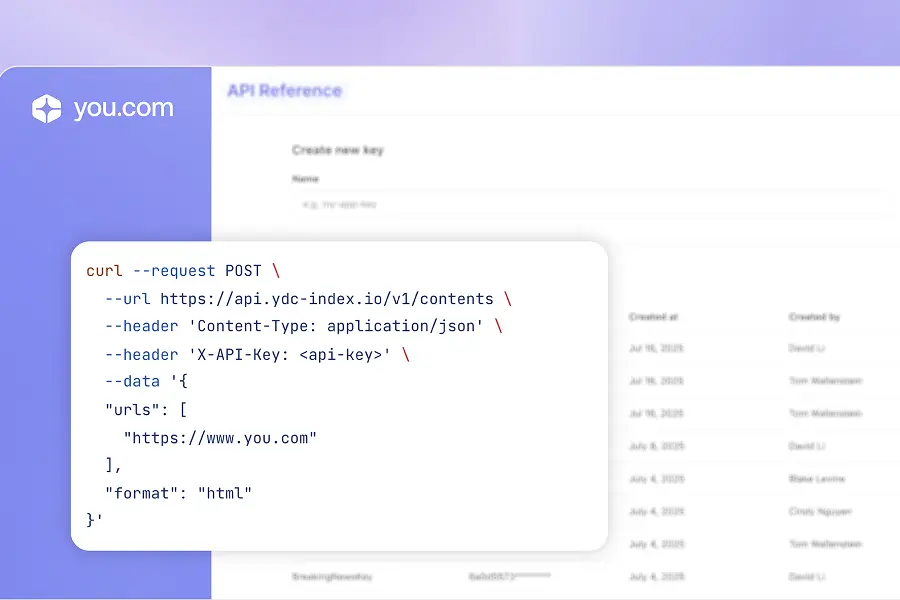
Real-time multi-source research requires APIs that deliver traceable, up-to-date answers with source verification. You.com provides a Search API for deploying compliant and reliable agents.
Practical Steps to Implement AI Research Agents in Your Business
Organizations can follow four proven steps to deploy research agents that deliver measurable value while avoiding common pitfalls.
1. Assess specific research needs and data sources. Start with concrete use cases that solve painful research problems—market intelligence, lead generation, or research acceleration are common starting points. Document your existing manual processes: how long do they take, where do bottlenecks occur, and which data sources matter most? This assessment, covering proprietary databases, internal documents, and public information, creates clear success criteria for measuring ROI.
2. Choose composable, model-agnostic infrastructure. Single-model architecture ships faster since you optimize for one model's behavior. Model-agnostic infrastructure with composable APIs requires more upfront work but provides flexibility as AI models evolve. The Search API from You.com allows teams to route queries across different models and compose atomic building blocks rather than using rigid endpoints.
3. Develop custom agents using no-code or API-driven approaches. Start with pre-built modular components and customize for specific needs rather than building from scratch. Industry requirements vary across finance, healthcare, legal, and retail verticals, so flexibility matters here. Research teams without engineering resources can use no-code interfaces to create specialized agents, while more technical teams can use APIs to build custom agents integrated with internal systems.
4. Monitor performance with transparent metrics and optimize for ROI. Track both technical performance (accuracy, latency, uptime) and business impact (time saved, research quality, decision outcomes). These metrics vary by use case and organizational priorities, but a data-driven approach helps identify which capabilities deliver the greatest returns—allowing teams to focus on high-value features and continuously improve results.
Organizations implementing these steps avoid the most common pitfalls: technology-first approaches that ignore actual research needs, single-vendor dependencies that create future migration headaches, and unmeasured deployments that can't prove their value.
Why AI Research Agents Matter for Modern Teams
Integrating AI agents into research workflows reduces the time required for the most complex and time-consuming tasks. As a result, analysts can spend less time gathering and verifying information and more time developing strategic insights while decision-makers receive better-documented, more comprehensive research with every claim traced to primary sources. This traceability creates accountability and auditability critical for high-stakes decisions.
You.com provides self-service API access with SOC 2 compliance to address these deployment barriers. Try the API key for free or, if you’re looking for even more info, book a demo.
Frequently Asked Questions
What is an AI research agent?
An AI research agent is an autonomous system that gathers, verifies, and analyzes information across multiple data sources to support decision-making. It combines five key components: perception module, knowledge base, reasoning engine, action generator, and learning module. AI research agents deliver citation-backed insights by orchestrating complex workflows that trace every claim to specific, verifiable sources.
How do AI research agents differ from traditional automation or chatbots?
Traditional chatbots generate single responses based on training data, while research agents verify real-time information across multiple sources and maintain context across extended operations. Research agents implement iterative planning that decomposes complex goals into subtasks, executes them conditionally, and adapts based on intermediate results. Simple automation tools execute predefined sequences while AI research agents deliver citation-backed insights that enable independent verification of every claim.
Can AI research agents be customized for my organization's data or workflows?
AI research agents can be fully customized to integrate with proprietary databases, internal documents, and specialized workflows specific to your organization. Plus, organizations can use no-code interfaces or API-driven approaches to create specialized agents tailored to their specific research needs and data sources. This customization enables teams to build on proven components rather than starting from scratch, reducing time-to-value while maintaining flexibility.
How can I ensure data security and compliance when deploying research agents in my organization?
Select platforms with zero data retention capabilities, SOC 2 compliance certification, and transparent data handling practices that prevent queries from being stored or used for training. Implement fine-grained access controls through self-service SSO that enables precise permissions aligned with existing governance structures. Evaluate vendors based on specific security controls and certifications rather than vague "enterprise-grade" claims, and ensure comprehensive audit trails document all research agent activities.

.png)
.webp)





.png)