TLDR: Model Context Protocol (MCP) is a new protocol that lets AI agents discover and use business tools at runtime, making integration more flexible and adaptive than traditional APIs or SDKs. While it enables rapid innovation and modular architectures, it also introduces new security and performance considerations that organizations must proactively manage.
MCP servers are already running in your organization. The question isn't whether to adopt Model Context Protocol—it's whether you'll govern it proactively or respond to security incidents reactively.
Anthropic released MCP in November 2024 to solve a core problem: large language models lack real-time data access and cannot interact with business systems on their own. MCP addresses this through runtime discovery. Instead of hardcoding connections to each tool, AI agents query MCP servers to learn what's available and how to use it. Add a new tool, and agents can find it automatically without code changes.
This flexibility makes MCP attractive for enterprise developers building multi-tool AI agents. Security-critical and latency-sensitive applications, on the other hand, should stick with direct APIs where mature frameworks and minimal overhead matter more than runtime adaptability.
This guide covers how MCP works, compares it to traditional APIs and SDKs, and explains when MCP makes sense for enterprise implementations.
How Protocols Enable New Architectures
One of the pivotal innovations in modern computing is the clear separation between protocol and implementation. This distinction is fundamental for CTOs and technical leaders to grasp, as it underpins the agility and scalability of today's most successful digital architectures—including those powered by the MCP framework.
Protocol vs. Implementation: Why the Distinction Matters
A protocol defines what should happen: it is an abstract set of rules and message formats that governs how different components interact, communicate, and exchange data. In contrast, an implementation refers to how those rules are realized via software or hardware systems.
Why is this separation so powerful?
- Interoperability: When the protocol is standardized, any number of implementations—written in different languages, running on different platforms—can communicate seamlessly, as long as they adhere to the protocol. This opens the door for heterogeneous, polyglot architectures and enables collaboration across organizational and technical boundaries.
- Flexibility & Upgradability: Architects are free to upgrade, swap, or refactor implementations without breaking the overall system, provided the protocol remains consistent. This decoupling reduces technical debt and increases the longevity of core infrastructure.
- Innovation: Teams can experiment with new technologies or performance optimizations in specific implementations without risking systemic incompatibility. This fosters a healthy ecosystem of competing solutions, all speaking the same language.
The Benefit of Protocol-Centric Architectures
Protocol-centric architectures (like those enabled by MCP) give organizations room to evolve rapidly. Instead of building monolithic, tightly coupled systems, you can design your infrastructure as a set of modular, interchangeable components. Each component can be built, maintained, or replaced by different teams—or even third-party vendors—so long as everyone speaks the same protocol.
This approach:
- Reduces vendor lock-in
- Streamlines integration of new tools and services
- Supports scalable, distributed, and resilient architectures
By focusing on robust, well-designed protocols and treating implementations as pluggable and replaceable, technology leaders can build systems that are future-proof, adaptable, and ready for continuous innovation. MCP exemplifies this philosophy, empowering organizations to harness the full potential of modular, protocol-driven architectures.
MCP vs. APIs vs. SDKs
When integrating AI with external systems, developers have several architectural options, each with its own strengths, trade-offs, and potential pitfalls. Traditional approaches like APIs and SDKs have been the backbone of software integration for years, offering predictable patterns but also imposing certain limitations, especially in dynamic or agent-driven environments. MCP (Machine Communication Protocol) introduces a different paradigm—enabling more flexible, adaptive patterns designed specifically for AI agents.
In this section, we'll explore how MCP, APIs, and SDKs compare, focusing on their respective failure modes, adaptability, and the kinds of architectures they enable. This comparison will help clarify when and why you might choose one approach over another as you build next-generation AI-powered systems.
| Feature/Aspect |
APIs |
SDKs |
MCPs |
| Integration Method |
Fixed contract via documentation |
Language-specific libraries wrapping APIs |
Dynamic discovery by AI agents |
| Change Sensitivity |
Client breaks on API changes |
Each SDK must be updated when API changes |
Adapts automatically to changes |
| Version Management |
Centralized at API level |
Multiplied across every SDK and language |
Minimal; protocol-based |
| Developer Effort |
Manual updates and redeployment |
Manual updates across SDKs and apps |
Little or none after initial integration |
| Security Maturity |
Decades of real-world hardening |
Inherits API’s security, but SDKs may add complexity |
Emerging; less battle-tested |
| Overhead |
Minimal at runtime |
Varies (SDK size, dependencies) |
Higher protocol overhead |
| Flexibility |
Low; rigid interface |
Medium; some abstraction and convenience |
High; designed for dynamic environments |
APIs, SDKs, and MCPs form a layered ecosystem: APIs provide the foundation, SDKs make APIs easier for developers, and MCPs make APIs discoverable and usable for AI agents. Rather than replacing each other, they work together to serve both traditional and AI-driven applications
Build AI Agents with Real-Time Data Access
MCP trades integration simplicity for protocol complexity, and that trade-off pays off when your agents need to discover and use tools dynamically. When you need sub-100ms responses or your compliance team wants battle-tested security, direct APIs remain the better choice. The protocol is still maturing, so expect rough edges. But for teams building agents that need to adapt to new tools without redeployment, MCP delivers something traditional integration approaches can't.
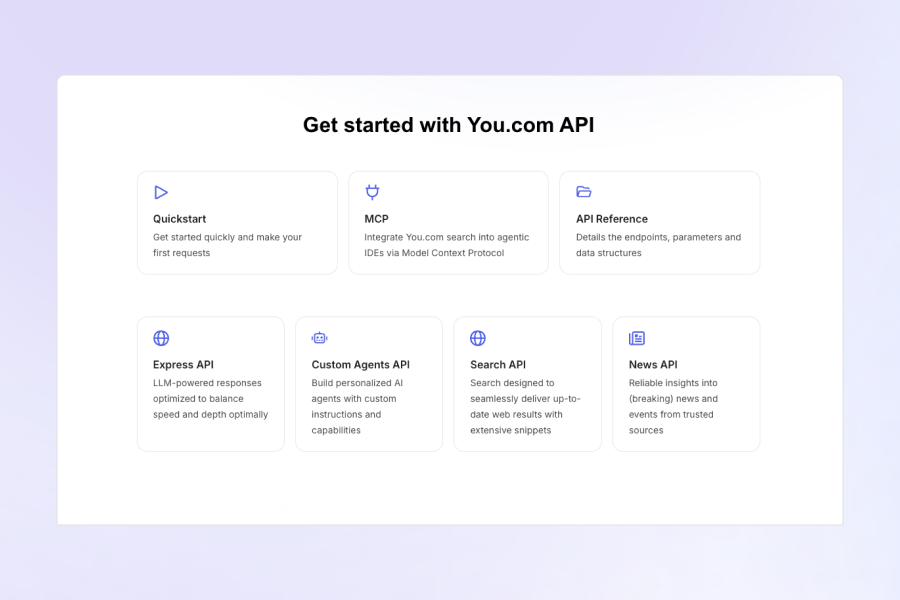
You.com offers an MCP-compatible server for web search and news retrieval with no data retention and standard transport that works out of the box with Cursor and similar tools. Book a demo to see it in action.
Frequently Asked Questions
What is Model Context Protocol?
MCP is an open standard for connecting AI agents to external tools through runtime discovery. Released by Anthropic in November 2024, it was adopted by OpenAI (March 2025), Google (April 2025), and Microsoft (Build 2025). The protocol enables AI systems to discover available tools at runtime without hardcoded integrations, functioning as a universal interface that works across different tools without custom wiring.
What are the limitations of MCP?
Limitations depend on implementation, not protocol. Context window overload is a risk if servers expose too many tools or verbose descriptions, but hosts like Claude Desktop implement features like tool_search to manage this. Performance overhead is <100ms for well-implemented servers but can be significant for poorly-implemented ones. Legacy systems running COBOL or mainframes face protocol translation challenges.
What are the security risks of MCP?
Security risks are deployment-specific, not protocol-inherent. Tool poisoning (malicious tool metadata manipulating AI agents) is an emerging threat. Malicious MCP servers have appeared: one popular NPM server quietly copied emails for weeks before detection. The protocol doesn't mandate authentication, so implementations must add transport-level security. Enterprise teams should implement server allowlists, dual-boundary sandboxing for internal workflows, and human-in-the-loop controls.
Does MCP support semantic search?
This question confuses protocol with implementation. MCP doesn't dictate search algorithms—that's an implementation choice. An MCP server can implement semantic search, fuzzy matching, embeddings-based search, or any algorithm. The protocol only defines how clients discover and invoke search capabilities, not how servers implement them.
Which languages support MCP SDKs?
Anthropic maintains official SDKs for TypeScript, Python, and Go. Community SDKs are emerging for Java, Rust, and C#. Most teams start by connecting to pre-built servers for Slack, GitHub, or PostgreSQL, then build custom implementations once they understand the patterns.
Should I use MCP or direct API integration?
It depends on your deployment context:
- Use MCP: Multi-tool agents, extensible platforms, dynamic workflows needing runtime discovery
- Use direct APIs: Fixed integrations, latency-critical operations (<100ms), regulated industries (evaluate MCP implementation maturity first)
- Use both: Many production deployments use MCP for flexible orchestration and direct APIs for performance-critical paths
Assess which of the four deployment levels apply to your organization and establish appropriate governance for each.
.png)
.jpg)
.webp)