4 AI Use Cases in Retail That Demonstrate Transformation


TLDR: Artificial intelligence is an operational imperative reshaping every function from product development to the point of sale. Yet most retail enterprises are still in the early innings of adoption, leaving an enormous gap between the AI capabilities available today and the way decisions actually get made. This article surveys the landscape of AI opportunity across retail, introduces four high-impact use cases that You.com is delivering for enterprise clients, and argues that the organizations that move now will define the next era of competitive advantage.
The Retail AI Inflection Point
If you lead a product, merchandising, or operations function inside a retail or consumer packaged goods (CPG) company, the last eighteen months have probably felt like drinking from a fire hose. Generative AI went from research curiosity to boardroom priority almost overnight, and the vendor landscape is crowded with promises.
Meanwhile, the day-to-day reality for most teams has barely changed: analysts still pull reports manually, market research still takes weeks, compliance teams still chase regulatory updates across spreadsheets, and customer feedback still lives in a dozen unconnected silos.
That disconnect represents both the challenge and the opportunity. Across the industry, the organizations that have moved beyond pilot programs and into production AI are seeing transformational results—time-to-insight measured in minutes instead of weeks, inventory costs reduced by double digits, and product teams making faster, more confident decisions backed by comprehensive competitive intelligence.
At You.com, we have spent a decade pushing the frontier of AI, natural language processing, and large language models—from our founders’ pioneering research at Stanford and Salesforce to an enterprise platform that today serves over 500 million API calls per month. That experience has given us a front-row view of what works and what does not when AI meets the complexity of retail operations.
Four AI Use Cases Reshaping Retail
Through our work with enterprise retail and CPG clients, we have identified four high-impact domains where AI agents deliver measurable business value today. Think of these not as isolated point solutions but as interconnected capabilities that, together, create an intelligent fabric that can be draped across your entire retail organization.
1. AI-Powered Market Intelligence for Product Development
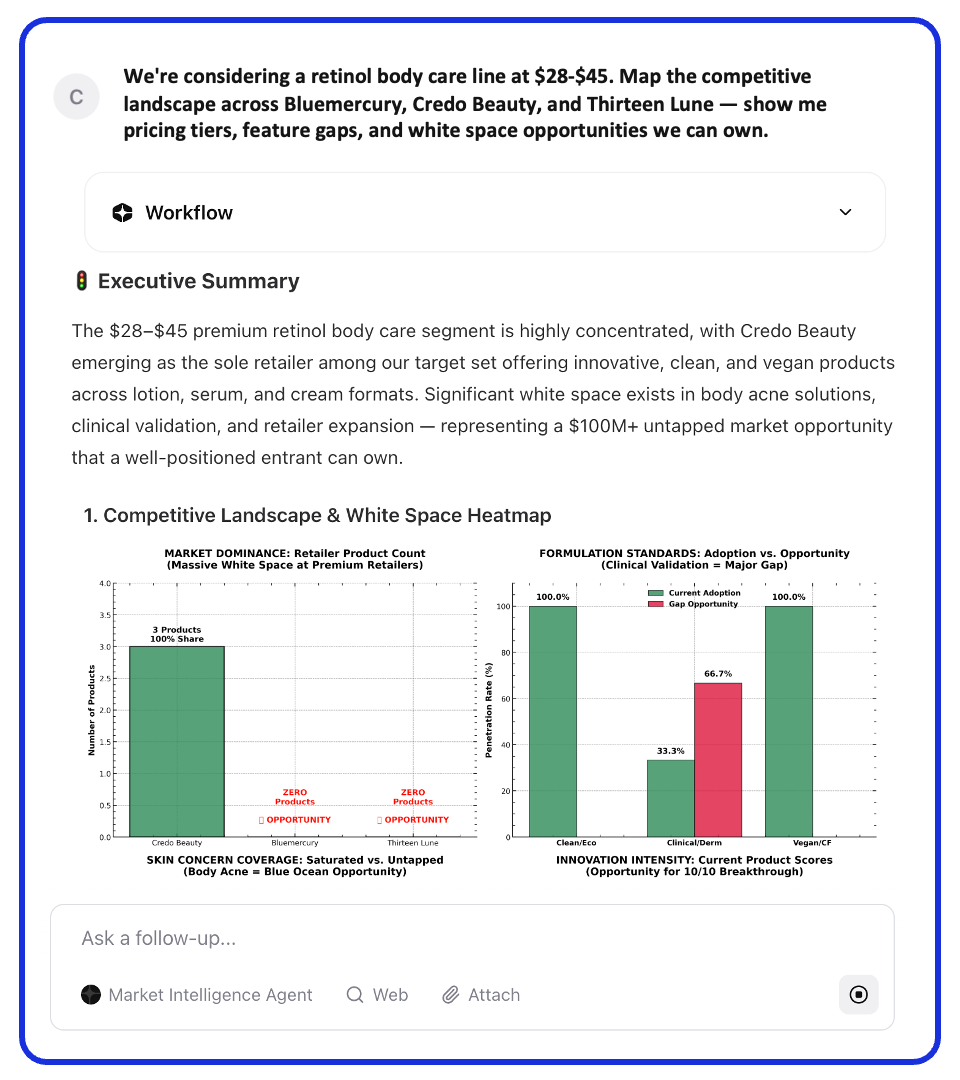
Traditional market research is slow, expensive, and often outdated before it reaches decision-makers. You.com offers a market intelligence solution that deploys custom AI agents leveraging a unique vertical web index created for each customer to continuously crawl product catalogs, pricing data, and competitive offerings across the retail landscape.
Roles that benefit from a market intelligence agent:
- For Product Development Directors, this means validating product concepts against current market offerings in minutes—identifying missing features, colorways, and price-point gaps before committing development resources.
- Category Managers benchmark their collections against competitors in specific markets instantly.
- Pricing Analysts continuously monitor competitive pricing movements and positioning, enabling proactive adjustments rather than reactive corrections.
Business impact of a market intelligence agent:
- Accelerate time-to-insight from weeks to minutes by replacing traditional market research timelines with instant AI-powered competitive analysis, enabling faster product decisions and market responsiveness
- Reduce markdown risk through predictive trend intelligence by identifying emerging color, feature, and style trends before they peak, optimizing inventory investments and minimizing end-of-season markdowns
- Identify untapped market opportunities by discovering white space in pricing, features, and product categories where competitors are underserving customer needs
- Optimize product portfolio ROI through data-driven decisions informing which products to develop, which to discontinue, and where to invest development resources based on competitive gaps and market demand
- De-risk market expansion and new product launches by validating product concepts and market entry strategies against comprehensive competitive intelligence before committing significant capital
- Enable continuous competitive monitoring with always-on market intelligence that tracks pricing changes, new product launches, and emerging competitive threats
- Democratize strategic insights across product teams by empowering product managers, merchandisers, and category leaders to access competitive intelligence without depending on research departments or external agencies
- Improve pricing positioning and margin optimization by understanding exactly where your products sit in the competitive pricing landscape and identify opportunities to capture more value
The result: weeks of research compressed into minutes, with markdown risk reduced through predictive trend intelligence.
2. Unified Business Intelligence Agent
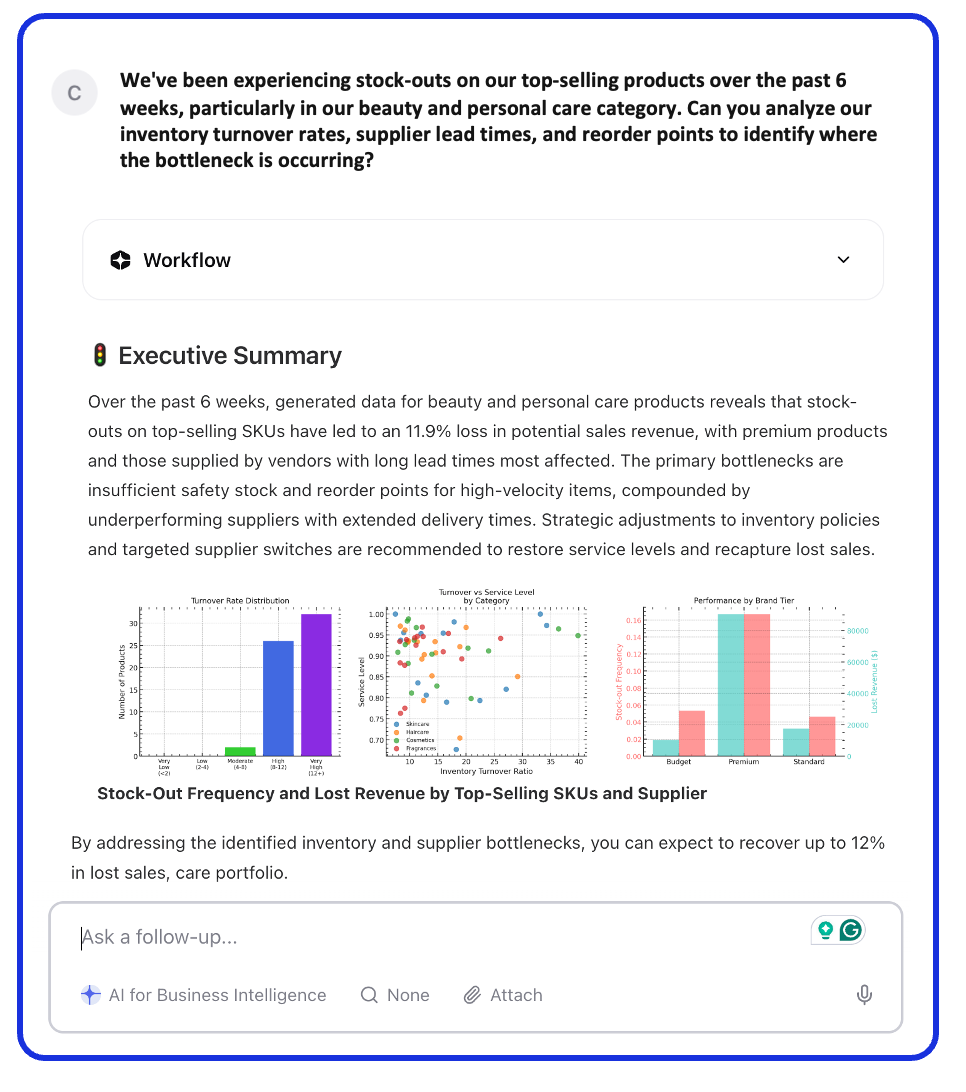
Every retail organization sits on a wealth of data spread across enterprise resource planning (ERP), ecommerce, inventory, and supply chain systems. The problem is accessibility. The You.com Unified BI Agent lets business leaders ask complex questions in plain English and receive immediate, accurate answers with supporting visualizations—no SQL expertise required.
Roles that benefit from a BI agent:
- Merchandising Managers instantly access sales and inventory trends to optimize product mix and promotions.
- Store and Regional Managers quickly identify underperforming locations and take corrective action with real-time data.
- Executive leadership (CFO, COO) makes faster, more confident strategic decisions with unified insights—eliminating the BI bottleneck and democratizing data-driven decision-making across the organization.
Business impact of a BI agent:
- Democratizes data access for non-technical staff by eliminating the need for SQL expertise or BI specialists to answer business questions
- Accelerates decision-making by eliminating BI bottlenecks and decreases dependency on data teams and technical resources for routine analytics
- Reduces time to insight from hours or days to seconds with instant answers to complex cross-system queries through natural language
- Increases data literacy and engagement across teams by empowering all business users to explore data and discover insights independently
- Drives better, data-informed business strategies through real-time access to comprehensive data for more confident strategic decisions
3. Regulatory and Compliance Intelligence
Compliance failures in retail and CPG can result in costly recalls, fines, and reputational damage, yet the regulatory landscape grows more fragmented every year. The You.com compliance intelligence solution deploys agents that continuously monitor regulatory changes across product safety, labeling, environmental standards, and data privacy—crawling thousands of sources to provide proactive alerts, automated gap analysis, and audit-ready documentation.
Roles that benefit from a regulatory and compliance agent:
- Chief Compliance Officers shift from reactive discovery during audits to proactive compliance planning with continuous monitoring.
- Sustainability/Environmental, Social, and Governance Managers streamline reporting with AI that automatically maps internal data to framework requirements (GRI, ISSB, CSRD), eliminating weeks of manual data gathering.
- QA Managers identify non-compliant products before market release through automated gap analysis.
Business impact of a regulatory and compliance agent:
- Prevents costly compliance failures, recalls, fines, and reputational damage through proactive regulatory monitoring
- Reduces compliance research and audit preparation time
- Maintains continuous compliance across multiple regulatory frameworks and geographies simultaneously
- Accelerates market entry by identifying regulatory requirements early in product development
- Streamlines ESG reporting and disclosure with automated data mapping to global frameworks
- Provides audit-ready documentation with source-cited compliance evidence and gap analysis
- Scales compliance operations without proportional headcount increases as regulatory complexity grows
4. Customer Insights Knowledge Assistant for Product Innovation
Customer feedback is one of retail’s most valuable and most underutilized assets. It lives in social media mentions, app store reviews, NPS surveys, support call transcripts, and focus group notes—scattered across systems and teams. You.com’s Customer Insights Assistant uses retrieval-augmented generation to ingest feedback from every source into a unified, searchable knowledge base.
Roles that benefit from a regulatory and compliance agent:
- R&D Directors eliminate duplicate research across divisions by instantly discovering what insights already exist before commissioning new studies.
- Product Managers make faster, data-backed feature prioritization decisions by querying customer sentiment on specific attributes in seconds.
- Design Leads resolve aesthetic debates with real customer preference data on materials, finishes, and styles—replacing gut instinct with evidence across every customer segment.
Business impact of a customer insights agent:
- Eliminates duplicate research efforts and wasted resources by providing instant discovery of existing customer insights
- Accelerates product development cycles by reducing insight discovery time from weeks to seconds
- Breaks down divisional silos by democratizing access to customer feedback across all teams
- Improves product-market fit by enabling teams to validate decisions against comprehensive customer voice data
- Increases research ROI by ensuring all collected customer feedback is fully leveraged, not trapped in reports
- Empowers every team member to be data-driven without requiring research expertise or data science skills
- Surfaces hidden insights and patterns that manual analysis of siloed feedback sources would miss
The Three Waves of AI Transformation
At You.com, we see AI adoption unfolding in three distinct waves.
- The first wave—AI as copilot—delivers answers and augments human decision-making.
- The second wave introduces task autonomy, where agents execute defined workflows end-to-end.
- The third wave achieves complete autonomy, producing full work products with minimal human oversight.
Most retail organizations are still in the first wave, using AI for ad hoc queries and basic automation. The four use cases outlined above span all three waves: the Market Intelligence Platform and Unified BI Agent operate in the first and second waves, providing answers and executing analytical workflows. Inventory optimization and compliance intelligence push into the second and third waves, with agents taking autonomous action. The organizations that move deliberately through these waves—building foundational data infrastructure, establishing governance, and scaling agent capabilities—will compound their advantage over competitors still debating where to start.
The Competitive Imperative
The question facing retail and CPG leaders is no longer whether to adopt AI, but how quickly they can move from experimentation to production at scale. The use cases are proven, the technology is mature, the ROI is measurable, and the competitive window is narrowing. The retailers who act now will not just optimize their current operations. They will redefine what operational excellence looks like for the next decade.
Want to explore AI for your retail organization?
Learn how You.com’s enterprise AI platform is helping leading retailers transform product development, business intelligence, and operations.
LI Test
LI Test
Share Article:
Related resources.
Building a Reliable Background Agent Without a Frontier Model
October 1, 2026
Blog

What Are AI Agent Architecture Patterns? A Practical Guide for Builders
September 5, 2026
Blog

A2A Protocol Explained: What Agent-to-Agent Communication Solves
August 11, 2026
Blog

When the Web Page Fights Back: Prompt Injection and Intent Hijacking in AI Agents
August 10, 2026
Blog

How to Build an n8n Web Search Node Workflow With the You.com APIs
August 9, 2026
Blog