TLDR: Semi-structured data is the flexible middle ground between rigid tables and raw content, carrying its own keys, tags, and nesting so systems can ingest it quickly without locking into a fixed schema first. That makes it ideal for APIs, event streams, logs, and AI workflows, but it also shifts complexity downstream into validation, querying, and cost control.
Every API response your team handles, every JSON payload flowing through a Kafka topic, every log event hitting your observability stack, that's semi-structured data. It's the format your AI pipelines actually run on, even if nobody sat down and chose it deliberately.
If your engineering team is building production applications that touch real-time web data, document stores, or LLM pipelines, understanding how semi-structured data works, and where it breaks, matters before you commit to an architecture.
What Is Semi-Structured Data, Exactly?
Semi-structured data sits between two extremes. On one side, you have structured data: rows and columns, fixed schemas, SQL databases where the shape of the data is defined before anything gets stored. On the other hand, you have unstructured data: images, video, raw text, content with no inherent organization that needs AI or NLP just to make sense of it.
Semi-structured data splits the difference. It doesn't conform to a rigid tabular schema, but it's not a formless blob either. Instead, it carries its own organizational markers (tags, keys, nesting) embedded directly in the data itself.
Here's what that looks like in practice. A JSON document from an API response has field names, nested objects, and arrays, but no external table definition dictating what fields must exist or what types they must be. The structure travels with the data, not ahead of it.
That's what makes semi-structured data practical. The embedded metadata (tags, semantic markers, key-value pairs) makes it far easier to catalog, search, and analyze than raw unstructured data, without requiring the rigid upfront schema that structured data demands.
Key Properties of Semi-Structured Data for Architecture Decisions
The real question isn't just "what is it." It's "what does this flexibility mean for the systems I'm building?"
Six properties define how semi-structured data behaves in production:
- No fixed schema required. Data can exist independently of any schema definition. You can ingest first and figure out the structure later (schema-on-read), which is the opposite of relational databases where the schema is a prerequisite for storage.
- Self-describing through embedded markers. Field names, tags, and type hints travel with the data. A JSON record tells you what it contains without consulting an external catalog.
- Hierarchical and nested. Semi-structured data often contains "nested data structures with no fixed schema," like arrays within objects within arrays, with variable depth.
- Dynamic typing. The same attributes within JSON can have values of different types across records. An attribute might be a string in one record and an integer in another.
- Gradual schema evolution. This is sometimes called "per-document schema flexibility," where new fields can appear without requiring migration scripts, and the schema evolves alongside the data.
- Schema-data independence. Unlike a relational table where the schema must exist before data enters, semi-structured data can land first. Storing data as a JSON string is resilient to new fields, structural changes, and type changes in the data source.
That flexibility is the core architectural trade-off. It gives you speed and adaptability at ingestion time. It also means every downstream consumer has to handle variability, which is where the challenges start.
Semi-Structured Data Formats: Choosing the Right One for Each Pipeline Stage
One thing teams learn quickly is that there's no single "best" semi-structured format. The choice depends on the pipeline stage and access pattern. Sophisticated production pipelines almost always separate concerns across different stages.
- JSON is the default for REST APIs, configuration, and LLM input/output. It's human-readable, universally supported, and self-describing. The trade-off: per-field name overhead on every record makes it inefficient for high-volume analytics, and data lake file formats like JSON require whole-file writes rather than row-level mutation, which is one reason teams convert raw JSON into analytical formats downstream.
- Avro is commonly used in streaming systems. It provides a compact binary format with the schema stored alongside the data, excelling in write-heavy use cases like data ingestion and streaming, particularly with Kafka.
- Parquet dominates analytical workloads. As a column-oriented format, it lets query engines read only the columns needed, which can reduce costs on platforms that bill by data scanned. Most open table formats use Parquet as the underlying storage layer.
- YAML owns the infrastructure configuration space. Kubernetes favors YAML over JSON for configuration files because it's cleaner to read and less noisy.
- Protobuf handles high-performance microservice communication. It's smaller and faster than JSON, but requires schema definition files to interpret, which adds version management overhead.
The pattern teams converge on is a mixed-format pipeline. JSON or Avro for ingestion (schema resilience, streaming compatibility), then conversion to Parquet for analytical layers (query performance, cost optimization). Many teams layer this further, landing raw data first and progressively cleaning and refining it for downstream consumers.
Why Semi-Structured Data Matters for AI Infrastructure
Semi-structured data isn't just relevant to AI infrastructure. It's the native format of much of the AI stack. Structured formats such as JSON, XML, and YAML are commonly discussed in the context of LLM inputs and outputs. The tooling built for managing semi-structured data pipelines is, in effect, the tooling managing your AI data infrastructure.
In Retrieval-Augmented Generation (RAG) systems, semi-structured data provides a specific advantage over pure unstructured text: metadata filtering during retrieval. JSON key-value pairs and document attributes let you narrow candidate documents by attribute values (date ranges, document types, source categories) before vector similarity ranking. That retrieval pattern is commonly used in RAG architecture discussions.
Agentic RAG systems can change retrieval strategy mid-flight based on context, which means the underlying data pipeline needs to handle schema-flexible semi-structured inputs at runtime. When an agent calls a tool, the response is often JSON with variable structure depending on the tool, and the next agent in the chain has to parse it without a guaranteed schema.
For teams building AI applications that need fresh, real-time web data, the You.com Search API returns LLM-ready structured results that fit directly into these semi-structured ingestion patterns without additional parsing overhead.
Semi-Structured Data Challenges at Scale
Semi-structured data's defining strength, schema flexibility, is also its primary operational liability. The challenges are predictable, but they're not trivial. These include schema drift, querying complexity, and cost at scale.
Schema Drift
Schema drift is the big one. When an upstream API or service changes its JSON structure without coordinating with downstream consumers, pipelines break silently. A common solution pattern is data contracts combined with dead-letter queues. Route non-conforming records somewhere recoverable, monitor DLQ volume as an early warning system, and formalize the producer-consumer relationship so schema changes become managed events rather than surprises.
Querying Complexity
SQL was built for flat tables, not nested JSON. Although SQL:2016 added JSON support, every major data warehouse (Redshift, Snowflake, BigQuery) implements its own approach to querying nested structures. That means your team's query patterns are partially locked to whichever platform you choose.
Cost at Scale
Cost follows directly from format choice. On platforms billing by data scanned, storing analytical data as raw JSON instead of Parquet means scanning more data than a columnar layout requires, which is why AWS documentation emphasizes columnar formats for cost reduction. Newer approaches like the Databricks Variant data type address this by automatically columnarizing frequently used fields, delivering significant read performance improvements over raw JSON storage.
On the other hand, these challenges have well-established solutions. Tools like Schema Registry for Kafka and layered data architectures collectively re-impose controlled structure without sacrificing the flexibility benefits that made semi-structured data the right choice in the first place.
Making the Architecture Call
Semi-structured data is the connective tissue of modern data infrastructure. It’s the format your APIs speak, your event streams carry, and your AI pipelines consume. Get the format trade-offs and failure modes wrong, and you'll feel it in your query costs, your pipeline reliability, and your team's ability to ship.
The consensus across cloud providers is clear. Accept semi-structured data in its native form at ingestion, then convert to optimized formats for downstream analytics while applying schema validation during processing. That layered approach gives you ingestion speed and analytical efficiency without forcing a choice between them.
If your team is building AI applications that need real-time semi-structured web data (search results, news feeds, page content) as inputs to RAG or agentic workflows, You.com provides composable APIs designed to deliver that data in LLM-ready formats, with the freshness and structure your pipelines need to produce accurate results.
Try the APIs for free or, to learn more, contact sales.
Frequently Asked Questions
When does a raw data landing layer become too permissive?
A landing layer is too permissive when bad records accumulate faster than downstream teams can classify and fix them. If field types change unpredictably or consumers start hard-coding one-off exceptions, the layer is no longer flexible. It's leaking unresolved schema decisions into every later stage.
What is the safest rollback plan when an upstream JSON schema breaks consumers?
The safest pattern is to quarantine non-conforming records, keep recoverable copies, and replay them after the contract or transformation logic is fixed. That works because semi-structured pipelines often retain raw source history at ingestion, letting teams remediate downstream without depending on the original producer to resend the data.
When is Avro the wrong choice even for streaming pipelines?
Avro is a poor fit when human inspection matters more than compact binary encoding, or when the same payloads need to be read directly by many loosely coordinated tools without schema handling in place. In those cases, JSON's readability or Protobuf's microservice focus may outweigh Avro's write-heavy ingestion advantages.
What usually signals it's time to convert JSON to Parquet?
The tipping point is usually repeated analytical access, not raw volume alone. If teams keep querying the same nested fields, paying scan-heavy costs, or building platform-specific JSON query workarounds, the data has moved from flexible landing use to analytical serving use. That's when columnar conversion starts paying for itself.
Where can teams quickly test semi-structured web data in an AI pipeline?
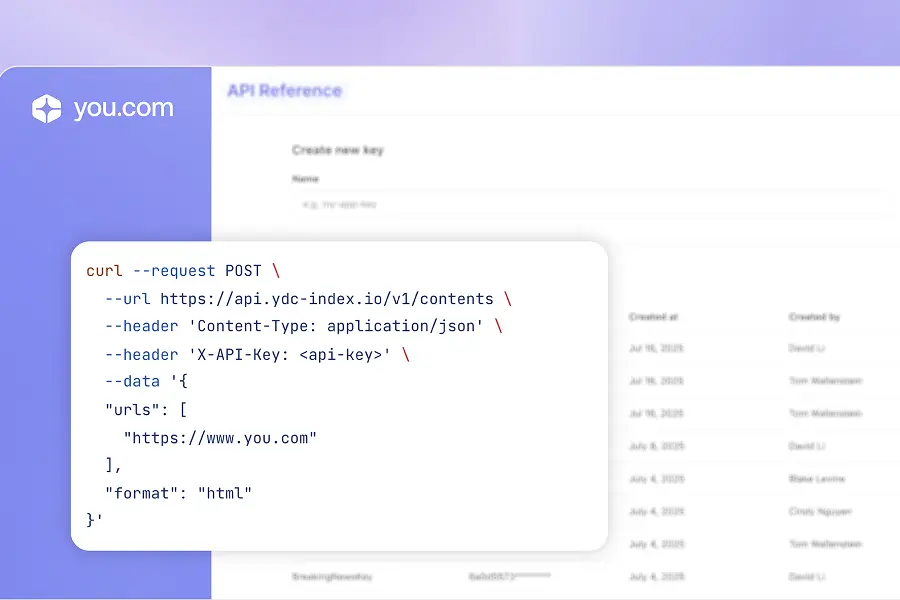
You.com is one practical option because its APIs return web and news results with source URLs and related metadata, and can extract full page content and metadata from specific URLs. That makes it useful for a small pilot. Ingest the response as-is, test metadata filtering in retrieval, and see where normalization is actually needed before designing a larger pipeline.

.webp)
.png)