Skip to navigation

Knowledge

Retrieve licensed prices, company metrics, scores, forecasts, and more alongside web results.
View as MarkdownOpen in Claude

Knowledge draws on hundreds of licensed and public sources to find answers to specific kinds of questions that can’t be answered on typical public web data alone.

A web search can find a company’s earnings release, but a question about its latest normalized quarterly revenue needs a specific metric and reporting period. A live exchange rate or a sports injury update may change before the next page is indexed. Knowledge brings licensed data sources into the Web Search API, so your application can use this specialized data alongside public web results in one request.

Each result includes a description of the answer, data-provider attribution, and, when available, the data’s recency. You can show the value and its provenance in a watchlist, feed it into an agent’s context, or compare it with the web results returned for the same query. Knowledge is included free in the Web Search API’s current price. No separate endpoint, contract, or charges.

Data You Can Retrieve

The data covers seven areas from several sources including, but not limited to: AccuWeather, Baker Hughes, BLS, CoinMarketCap, EIA, Nasdaq, Polymarket, QUODD, S&P Global, Sportradar, The World Bank, and YouGov.
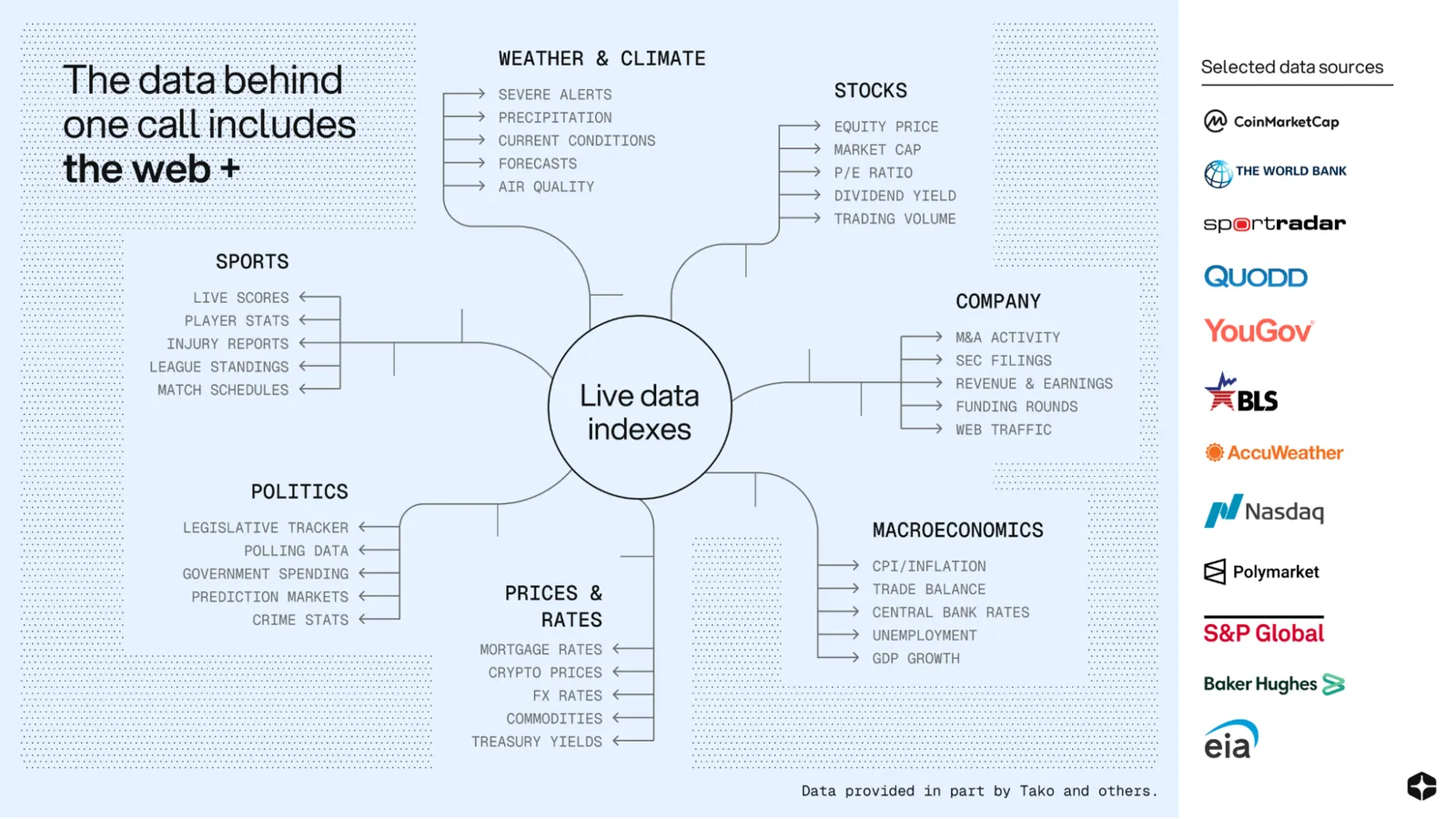
Knowledge coverage: one Web Search API call reaches live data indexes for stocks, company data, macroeconomics, prices and rates, politics, sports, and weather and climate, from sources including CoinMarketCap, The World Bank, Sportradar, QUODD, YouGov, BLS, AccuWeather, Nasdaq, Polymarket, S&P Global, Baker Hughes, and EIA

AreaExample dataWhat you can build
StocksEquity prices, market cap, P/E ratio, dividend yield, trading volumeA watchlist that pairs current prices with the latest company news
CompanyRevenue and earnings, SEC filings, M&A activity, funding rounds, web trafficA company brief that looks up a reported metric and its period before summarizing an earnings release
Prices and ratesCrypto prices, FX rates, commodities, mortgage rates, Treasury yieldsA currency monitor that shows an exchange rate beside news about a policy decision
MacroeconomicsCentral bank rates, CPI and inflation, unemployment, GDP growth, trade balanceAn economic dashboard that tracks rates and published indicators by reporting period
SportsLive scores, player stats, league standings, injury reports, schedulesA game companion that updates scores and injuries while showing related news
Politics and governmentGovernment spending, polling data, prediction markets, legislative activityA public-spending research tool that combines figures with coverage of a policy change
Weather and climateCurrent conditions, forecasts, severe weather alerts, precipitation, air qualityA delivery-risk view that pairs a forecast or alert with local reports

The runnable Knowledge examples include queries for each area. Availability depends on the query: Knowledge returns relevant records when it finds them, rather than a complete feed of every metric in an area.

How We Measured It

The VerticalRTK fast set contains 155 questions across seven areas, including company metrics, markets, government, and sports. Each question has a reference answer and an as_of value recording when that answer was true. That matters for prices, forecasts, and other moving figures: a stale reference answer can make a current result look wrong.

On this set, adding Knowledge to Web Search API results with highlights changed measured accuracy as follows:

ConfigurationAccuracy
Web Search API with highlights64.5%
Web Search API with highlights and "knowledge": "core"84.2%

The questions and reference answers are public. The fast set supplies data, not a scoring harness. To reproduce a comparison, pin the dataset version, recheck moving answers as the dataset instructions describe, and use the same answer-generation and grading method for both configurations.

What the Data Looks Like

The pane below demonstrates real behavior from Web Search with knowledge enabled.

Web results are omitted to keep the records short. The queries come from the VerticalRTK “fast” dataset: the public benchmark behind the accuracy numbers above.

Live values move. A stock price, crypto rate, or forecast returned today will differ from what the same query returns tomorrow. Each record includes an as_of date showing when its underlying data was captured.

What's Nvidia's stock price?

{
"results": {
"knowledge": [
{
"type": "answer",
"title": "Nvidia Stock Overview",
"attribution": [
{
"name": "Xignite",
"source_description": "Xignite is a US-based provider of financial market data APIs, acquired by QUODD in 2023."
},
{
"name": "S&P Global",
"source_description": "S&P Global is a US-based financial data and analytics company that provides data products and services to the financial industry."
}
],
"description": "Nvidia (Nasdaq Global Select: NVDA) stock price is $216.32 as of Oct 20, 2026 3:59 PM EDT. Current market cap is $5,233,379,310,000. On Oct 19, 2026, the stock opened at $218.09, traded between $214.70 and $219.62, and closed at $217.09, up $2.96 (1.382%) from the Oct 16, 2026 close of $214.13. The Oct 20, 2026 session opened at $215.96. Between Oct 20, 2025 and Oct 19, 2026, the stock closed between $165.17 and $239.24. The P/E ratio is 27.40. The P/S ratio is 16.57.",
"as_of": "2026-10-20"
}
]
},
"metadata": {
"query": "What's Nvidia's stock price?",
"latency": 0.3591
}
}

How to Enable Knowledge

Set "knowledge": "core" in the body of your POST /v1/search request, and you’ll start receiving data at no additional cost.

core is the only supported value right now.

This example asks for a company metric while retaining the web results for the same query:

curl -X POST https://ydc-index.io/v1/search \
-H "X-API-Key: $YDC_API_KEY" \
-H "Content-Type: application/json" \
-d '{
"query": "Nvidia latest quarterly revenue",
"count": 10,
"knowledge": "core"
}'

The Python example needs youdotcom 3.5.0 or later. Pair Knowledge with extraction_mode: "highlights" when the agent also needs query-relevant passages beside the licensed record.

Read the Response

Knowledge records appear in results.knowledge. Web results in the same response are unchanged. This example pairs a quarterly revenue record with a web result from the company’s earnings release:

{
"results": {
"web": [
{
"url": "https://nvidianews.nvidia.com/news/nvidia-announces-financial-results-for-first-quarter-fiscal-2027",
"title": "NVIDIA Announces Financial Results for First Quarter Fiscal 2027",
"description": "NVIDIA today reported revenue for the first quarter ended April 26, 2026."
}
],
"knowledge": [
{
"type": "answer",
"title": "NVIDIA Corporation Total Revenues (Normalized) (Quarterly)",
"description": "NVIDIA Corporation Total Revenues (Normalized) (Quarterly)'s latest value was $81,615,000,000 in Apr 2026, up 6,424.0% since Jan 2015.",
"attribution": [
{
"name": "Fiscal.ai",
"source_description": "Fiscal.ai is a financial data provider that publishes as-reported and standardized company financials, segments, KPIs, and ratios extracted from filings."
}
],
"as_of": "2026-04-26"
}
]
},
"metadata": {
"query": "Nvidia latest quarterly revenue",
"latency": 0.8123
}
}
FieldDescription
typeThe kind of result. answer is the only value returned today. Skip values you don’t recognize, since a new kind may carry different fields
titleA label for the record, such as the entity and metric it describes
descriptionThe answer in prose, including the value, period, and any history the provider supplies. It is not a separate numeric field
attribution[].nameThe data provider behind the record
attribution[].source_descriptionA short description of that provider
as_ofThe date the underlying data covers, as YYYY-MM-DD. Omitted when the provider reports no date

Up to 25 relevant knowledge results can appear. When none match the query, results.knowledge is omitted rather than returned as an empty array. Continue using results.web in that case. Attribution entries are credits, not clickable citations: they name providers but have no URLs. Display the provider name and as_of date beside a value when available, and don’t treat a missing date as a current timestamp.

Next Steps